
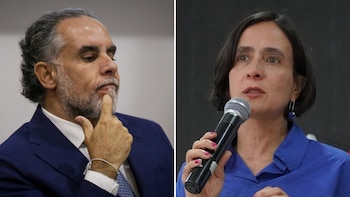
The Controversial Complaint Against Susana Muhamad: Attorney General’s Decision Announced
The recent decision by the Attorney General’s Office has stirred a significant amount of debate surrounding the dismissal of a complaint initially filed by Interior Minister Armando Benedetti against Susana Muhamad, a former Minister of Environment turned presidential candidate. The decision was grounded in an evaluation of evidence that ultimately found no substantial basis for a criminal investigation.
On February 4, during a session of the First Council of Television Ministers, Benedetti’s complaint arose from statements made by Muhamad, where she criticized his character and alleged past actions. The Attorney General’s investigation concluded that her remarks, made publicly during the ministerial meeting, did not compromise Benedetti’s honor or reputation.
Background of the Complaint
The issue at hand stemmed from an alleged insult and slander claim made by Benedetti against Muhamad. He argued that her comments not only tarnished his name but also impeded his credibility within the political landscape. In his pursuit of justice, he sought redress through the Prosecutor’s Office, claiming that Muhamad’s words suggested he had engaged in domestic violence.
In a notable statement during the Council of Ministers, Muhamad declared, “As a feminist and as a woman, I cannot sit at this cabinet table with Armando Benedetti,” implying that the allegations against him were serious enough to merit her refusal to work alongside him.
Judicial Agency’s Findings
The investigation, led by Marcela Abadía, a prosecutor with the Third Delegate before the Supreme Court, involved a conciliation hearing on July 28, during which both parties presented their cases. Despite requesting that Muhamad retract her statements, no resolution could be reached as she maintained her stance.
According to the Prosecutor’s findings, Muhamad’s statements were deemed to be expressions of opinion rather than criminal. The Prosecutor’s Office pointed out that while the remarks may have displeased Benedetti, they did not constitute a direct attack on his character. “This expression does not hold any lesivity that threatens unequivocally the honor or good name of the complainant,” concluded the report, reinforcing the protection afforded by the right of free expression.
Legal Implications and Political Context
The Attorney General’s ruling cited international standards on freedom of expression, notably referencing guidance from the Inter-American Commission on Human Rights (IACHR). The emphasis was placed on the fundamental rights that allow individuals to express dissent or critique authority figures, especially within a governmental context.
Political commentators have pointed out that this ruling underscores a critical democratic principle: the ability to engage in political debate without fear of retaliation or criminal charges. Benedetti’s complaint, while serious in nature, ultimately fell short of the rigorous standards required for a successful legal action.
According to the judicial report, it became clear that Muhamad’s remarks fit within the realm of public discourse and did not demonstrate any tangible damage to Benedetti’s reputation. As highlighted in the ruling, any commentary that might lead to discomfort does not automatically breach the threshold for criminal culpability.
Conclusion
The Attorney General’s decision not to move forward with legal action against Susana Muhamad marks a significant moment in political and judicial discourse in Colombia. By asserting the necessity for substantial evidence in defamation cases and emphasizing the right to free expression, the ruling strengthens democratic practices in the realm of political engagement. Mukamad’s unwavering stand for her beliefs not only highlights her commitment to feminist principles but also underscores the complex intersection of politics and personal integrity in Colombia today. As the political landscape evolves and divisions deepen, the emphasis on the right to contest, criticize, and speak freely becomes ever more paramount.