
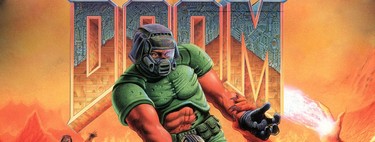
John Romero’s enthusiasm is contagious : he firmly believes that while he continues to delve into programming , his main role has increasingly become that of an educator, spreading the legacy and evolution of Doom . As one of the original creators of this iconic game, Romero explains that even decades later, it remains a favorite among countless fans. This passion was palpable at the Comic-Con de Málaga , where he shared insights on what he considers the essential elements of the First-Person Shooter (FPS) genre.
Romero vividly recalls how the original Doom is now regarded as a technical marvel . He emphasizes that from the very beginning, they recognized the need for the game to have an infernal speed to stand out among its competitors. “We needed to design new techniques to create light and dark in a 3D world while maintaining high frame rates,” he explains. The challenge of achieving such speeds was nothing short of monumental.
To reach that level of speed, they had to invent new ways of creating 3D graphics. “Initially, Doom resembled what we had done in Wolfenstein 3D because we were mentally still focused on that older style,” he states. While Wolfenstein featured completely illuminated 90-degree walls, Doom introduced elements like stairs, dark corridors, and enormous open spaces with countless monsters—an unprecedented sight in gaming at the time. “We had no references. We could only create, test, invent, and try to improve it little by little.”
Romero’s excitement extends beyond speed. “The sound, the multiplayer features (which was revolutionary, allowing cooperative and Deathmatch modes), and the ability for players to modify the game were all crucial elements. We aimed to launch it for Christmas—a genuine madness,” he laughs, recalling the pressure of that schedule while highlighting the fun they had in designing it.
History Matters
While many argue that Doom lacks depth in its story, Romero clarifies that this does not detract from its ability to create an engaging atmosphere and narrative. “There was a general story inspired by Dungeons & Dragons (D&D),” he elaborates. “I always strive to make games that differ from anything players have experienced before. With Wolfenstein 3D , players confronted Nazis head-on, and we had to reinvent how we approached storytelling in Doom.
Romero’s team aimed for a distinctive experience. “We could not have a science-fiction game solely focused on killing aliens, as that would be expected. The story for Doom emerged from our experiences in D&D,” he explains. “We added elements from movies like Aliens , drawing inspiration from the space marines and the tension-filled action that comes with having numerous enemies wanting to defeat you.”
When asked to summarize the enduring influence of Doom , Romero identifies both technical and cultural impacts. “Technically, we propelled the industry toward 3D gaming . Overcoming long-established norms is never easy, especially as dedicated hardware was heavily tailored for side-scrolling games of the 80s,” he reflects.
Romero highlights how, at that time, gaming was shifting. “Home computers and consoles were equipped with specialized chips. Major investments were funneled into R&D.” Despite such advancements, Romero and his team chose to prioritize 3D graphics when most were still focused on 2D. “We aimed to create a revolutionary experience using the technology available to us,” he states.
Technology at Full Speed
One of the most significant technological advancements in Doom was its integration of multiplayer gameplay . “Today, it’s rare to find a game that doesn’t integrate multiplayer. However, when we introduced it, we made it a seamless part of the experience rather than a standalone feature,” he explains. This was included during the final months of the game’s development, a decision driven by urgency but ultimately a crucial evolution in gaming.
On a cultural level, Romero notes the widespread impact of Doom. “We were among the first to incorporate heavy metal music into a commercial game,” he remarks. Yet, the most pivotal moment was when ID Software decided to freely share modifiability features. “In 1993, we launched the game, and by 1997, we published all the source codes,” he states, highlighting how this move allowed the player community to take ownership of the game and flourish.
Romero believes this was essential for fostering a vibrant community around Doom : “We communicated transparently with our players and encouraged them to modify the game. This community involvement made it better and more expansive,” he adds, emphasizing how the game was designed to be user-friendly on everyday computers. “We wanted to ensure that Doom could run on common hardware—this was crucial for its accessibility, ensuring everyone could enjoy it regardless of their setup.”

As our interview reaches its conclusion, we reflect on the concept of shareware and how Romero’s decision to give players access to the game reshaped the industry. “Many companies focused on selling boxes and screenshots, meanwhile, our philosophy was about letting people play first and decide later,” he notes proudly. The legend and innovation that is Doom resonates even today, solidifying its status as one of the most significant milestones in gaming history.