
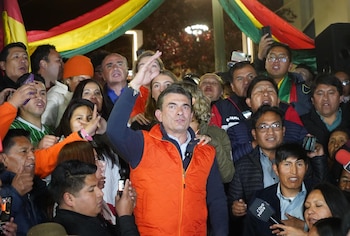
Bolivia’s General Elections: PDC Leads the Pack
The recent general elections in Bolivia have captured the attention of political analysts and citizens alike. Preliminary data released by the Supreme Electoral Court (TSE) indicates that the Christian Democratic Party (PDC) is currently leading with approximately 30.35 percent of the votes. This leads to notable implications for the country’s democratic landscape.
According to the TSE, the PDC, under the leadership of Rodrigo Paz Pereira , secured about 1,150,000 votes . This noteworthy achievement positions them as the frontrunners in what many are calling a transformative election. Pereira, who was declared the winner of the first round of the presidential election just days earlier, aims to leverage this momentum into a comprehensive victory.
Trailing closely behind is the Free Alliance , led by current Bolivian President Jorge Tuto Quiroga , who has garnered around 28.46 percent of the votes, equating to just over 1 million ballots . The political rivalry is intensifying as these two candidates prepare to contend for the presidency, further igniting interest in the election that will primarily take place on October 19 .
Third in line is the political grouping known as Unity , headed by businessman Samuel Doria . Currently, they are representing just over 21.5 percent of the votes, reflecting support from roughly 800,000 citizens . This nearly mirrors the trends observed in past electoral cycles, suggesting a stable, if not predictable, voter base.
Meanwhile, the Popular Alliance , helmed by Andronón Rodríguez , and the APB – Admate have both faced challenges this election cycle, managing to capture less than 10 percent of the vote. It appears that the Movement Towards Socialism (MAS) , the governing party, has faced a significant defeat, receiving a mere 3 percent of the votes. This decline may suggest discontent amongst voters regarding the current administration’s policies and governance.
Additional statistics reveal the political landscape’s shifts: the PDC is expected to secure 45 deputies in the national assembly, while the Free Alliance may achieve 37 deputies . Other parties like Unity , Súmate , and Popular Alliance are projected to secure varying degrees of representation, with a further eight deputy positions still uncertain, underscoring the contested nature of this election.
Moreover, early projections indicate that the PDC could secure thirteen senators , while the Free Alliance may attain eleven seats in the senate. It remains to be confirmed which party will fill the remaining five senatorial seats, a factor that could sway the balance of power within the assembly and influence decision-making processes moving forward.
The rapid counting by Ipsos , in collaboration with Bolivian television network Unitel , has provided snapshots of public support and voter sentiments. These insights indicate a waning influence of the ruling MAS party, pointing towards a broader societal shift in political allegiances throughout Bolivia.
As these early results unfold, the relationship between the parties and their supporters will be critical in shaping the direction of Bolivia’s governance and democratic engagement . Voter turnout and engagement will remain pivotal themes as the final results are tallied and the citizens await the final decision regarding their next leader. The implications of the PDC’s lead and its ongoing competition with free alliances present a dynamic political narrative that is essential for stakeholders and observers to follow closely.
In conclusion, the 2023 general elections in Bolivia serve as a critical juncture for the country’s future. The outcomes reflect not just voter preferences, but also the evolving political dynamics that may shape the government for years to come. As the electoral process progresses, it will be crucial to monitor how these shifts influence policies, governance, and the day-to-day lives of Bolivian citizens.