
The Origins of Popeye: A Sailor’s Journey to Global Icon
The Birth of a Cultural Icon
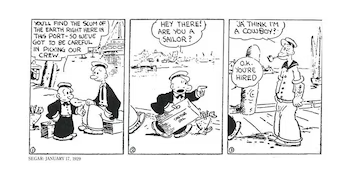
On January 17, 1929, a character named Popeye the Sailor made his debut in the American comic Thimble Theatre, created by cartoonist Elzie Crisler Segar. Initially, Popeye was merely a secondary character, overshadowed by others like Olivia Oyl and Castor Oyl. However, his unique traits and rebellious spirit soon captured the audience’s hearts, transforming him into a central figure in 20th-century culture.
A Unique Character Design
Popeye first appeared as a rugged sailor. With his half-closed eye, trademark pipe, and exaggerated forearms, he was anything but conventional. Speaking with a distinct, rough dialect and showcasing a direct and often violent demeanor, Popeye quickly set himself apart from more polished characters. His first words—a humorous misinterpretation of being hired as a sailor—immediately established his quirky charm.
Segar’s Creative Journey
Elzie Segar, born December 8, 1894, in Chester, Illinois, faced numerous rejections before successfully creating Popeye. His artistic journey included various jobs, including house painter and film projectionist. A correspondence course on humorous drawing helped refine his skills. By the time he presented Thimble Theatre to King Features Syndicate in New York, the comic was relatively unremarkable until it introduced the iconic sailor.
The Rise to Fame
Within weeks after Popeye’s introduction, reader demand surged. His popularity soared, which led Segar to elevate Popeye’s role within the comic. By August 1929, Popeye’s character was intimately tied to that of Olivia Oyl, marking the inception of a tumultuous love story that would engage readers for years to come.
The Spinach Connection
Interestingly, Popeye did not initially derive his strength from spinach. His original source of power involved fantastical elements, such as a magical chicken. This changed in 1931 when spinach became his iconic superfood. The connection between Popeye and spinach resulted in a significant rise in spinach consumption across the United States during the 1930s, making him an informal promoter of healthy eating.
Birth of a Multimedia Icon
Popeye’s leap into mainstream culture accelerated in 1933 when Max and Dave Fleischer began producing animated shorts featuring the sailor. These adaptations captured his distinct voice and rough charm, solidifying his status alongside animation giants like Mickey Mouse and Betty Boop.
Global Recognition
Popeye’s undeniable influence extended to toys, clothing, and various merchandise, establishing him as a global brand. In 1937, a statue was erected in Crystal City, Texas, the “Spinach Capital of the World,” to honor Popeye’s contribution to increasing spinach consumption.
Legacy and Memorials
Elzie Segar passed away in 1938, never fully witnessing the cultural impact of his creation. Nevertheless, Popeye has continued to thrive through various adaptations and remains a recognizable figure around the world. Today, he symbolizes resilience, humor, and the importance of healthy eating.
Conclusion
Popeye’s remarkable journey from a minor comic character to a global icon underscores the power of storytelling and character. January 17, 1929, marks not just the birth of a sailor but the inception of a beloved cultural symbol, making Popeye a true testament to perseverance and the quirky charm of comic artistry.