
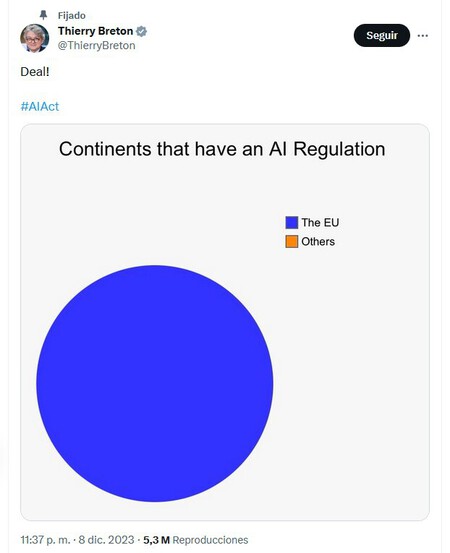
December 8 marked a pivotal moment for the European Union when the AI Act, a significant regulation concerning artificial intelligence, was approved. Thierry Breton, the European commissioner, expressed his enthusiasm via a tweet that quickly became a meme.
Responses to that tweet highlighted a stark disagreement: the perceived achievement of the EU was, in fact, a self-inflicted stumbling block. Critics argue that these regulations only serve to hamper innovation, making it increasingly difficult for Europe to compete in a sector that is fundamentally reshaping the global landscape.
Global Implications: Europe’s Standstill
While the US and China surged ahead in AI development without seeking permission or issuing apologies, Europe found itself stagnating. The AI regulation, set to be implemented in August 2024, resulted in a dichotomy within the AI sector: Europe is nearly at a standstill while the rest of the world accelerates headfirst into advancement, often disregarding potential repercussions.
The fallout of this decision has been evident over the past two years. Europe has seemingly been relegated to a secondary role, overshadowed by the dominance of the US and China. While there are notable exceptions like Spain’s Freepik and France’s Mistral, the overall landscape presents a concerning lack of innovation and competitiveness in AI.
Revising Digital Regulations: Is It Too Late?
Recently, the European Commission unveiled proposals aimed at simplifying various digital regulations, particularly affecting the General Data Protection Regulation (GDPR). This initiative aims to ease restrictions on sharing anonymized personal data, crucial for AI companies to develop and train their models legally while adhering to GDPR requirements.
Moreover, the proposed amendments soften critical aspects of the AI Act. The regulations governing high-risk AI systems, which were supposed to be activated in Summer 2024, will now only kick in once “the necessary standards and supporting tools are available.” This vagueness raises questions about the timeline and feasibility of implementing these regulations.
Amendments and Their Impact
One key element of the proposed changes includes simplified documentation requirements for small and medium enterprises (SMEs) and a unified interface for reporting cybersecurity incidents. Henna Virkkunen, the Vice President for Technological Sovereignty at the European Commission, noted the importance of reducing bureaucratic burdens on startups and promoting innovation by opening access to data. However, this push for innovation must still consider the need to protect users’ fundamental rights.
Concerns Over Privacy Protections
However, the proposed changes raise alarm among privacy advocates. As reported by The Guardian, there is a growing concern that these amendments could facilitate the collection and use of personal data for AI model training without explicit user consent. The European Digital Rights (EDRi) warns that the changes could undermine the stringent privacy protections that the EU has fought hard to establish.
This sentiment echoes the concerns raised by former Italian Prime Minister Mario Draghi, who catalyzed discussions about Europe’s lag in technological progress. While business groups have welcomed the proposed changes, many feel that the efforts are insufficient to reclaim Europe’s position as a leader in technology.
A Shift in Cookie Regulations
Another area of digital compliance under change is cookie regulations. The EU’s proposals aim to streamline the user experience surrounding cookie consent, making it easier for citizens to accept or reject cookies with a single click. This change could significantly improve online navigation, alleviating the daily frustrations caused by constantly appearing cookie banners.
The future of cookie consent management may hold promising developments, including potential integration directly into browsers. Once users configure their preferences, websites will automatically respect these choices for six months, enhancing overall user experience.
Ultimately, while the EU works to modernize its digital landscape, striking a balance between fostering innovation and safeguarding privacy remains a significant challenge. Whether these reforms can reinvigorate Europe’s standing in the global tech race remains to be seen.