
November’s Weather Forecast: A Blessing from England
The most beautiful, interesting, and hopeful thing about November has emerged from a cold building in Reading, England: a weather forecast. The European Weather Forecast Center has recently raised an alarm with its seasonal readings, indicating a significant event: a negative North Atlantic Oscillation (NAO).
The Implications of a Negative NAO
This finding is especially exciting for Spain. To understand its impact, we must first explain what the NAO is. The ‘North Atlantic Oscillation’ represents the dynamic between the Azores anticyclone and the Icelandic low—two major atmospheric phenomena that significantly influence North Atlantic meteorology.
A negative NAO indicates that the Azores anticyclone is weaker than usual, which results in a heightened inability to block intense Atlantic storms. Consequently, these storms tend to circulate further south than normal, impacting regions like Spain directly.
This is essentially what the European Centre for Medium-Range Weather Forecasts (ECMWF) has indicated from its headquarters in Reading.
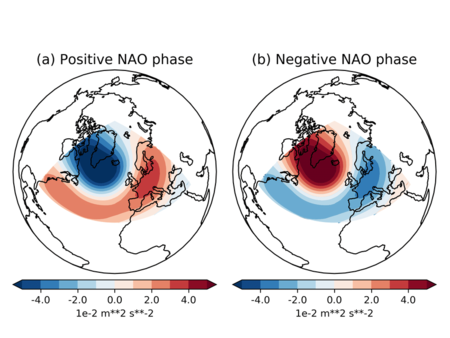
Kristian Strommen et al. (2021)
An Increasingly Certain Prediction
This is not just a solitary prediction; experts have been consistently warning about a winter forecast for 2025-26 that is likely to be shaped by La Niña and a potentially weaker polar vortex. This suggests a greater chance of cold spells in southwestern Europe.
This dual confirmation bolsters our seasonal predictions, which, despite their generic and uncertain nature, carry a sense of hope.
Why This Matters
The implications for Spain are significant. An increase in the frequency of cyclones deviating south can favor Atlantic storms, which directly affects reservoir levels and the energy market. Such meteorological changes signal good news for energy prices and water supply management.
Trusting the Prediction
How much can we rely on these forecasts? Moderately. There’s no question that meteorologists have improved their skills in recognizing trends. However, making predictions for seasons and months introduces greater uncertainties than those for short-term forecasts.
It’s crucial to view this as a probability rather than a definitive outcome. We should interpret it as a risk or probable scenario. In the vast range of potential outcomes, this trajectory appears to be the most plausible.
In conclusion, if these predictions hold true, our reservoirs—and ultimately, our communities—will feel the benefits this winter.
Image | WeatherModels
In Xataka | Ski resorts without snow at the end of the century: the most pessimistic models show what could happen in our high mountains.