
When we think of Xiaomi, its mobile phones typically come to mind, or perhaps its recent venture into electric vehicles with models like the SU7. However, the company’s latest move signals a much more ambitious direction: a competitive entry into the artificial intelligence arena. With the launch of the MiMo-V2-Pro, Xiaomi aims to place itself among the most advanced systems while focusing on affordability, effectively shifting the industry conversation.
What Xiaomi Proposes
Xiaomi positions its model as a “brain” designed for executing complete tasks rather than merely responding to specific queries, a feature characteristic of agent-oriented models. Official specifications indicate an architecture that exceeds one trillion total parameters, despite activating only 42 billion during each operation. The model boasts the ability to process contexts of up to one million tokens, enabling it to maintain long, complex processes without fragmentation. This design is particularly beneficial for extensive tasks and demanding workflows.
Performance Against the Greats
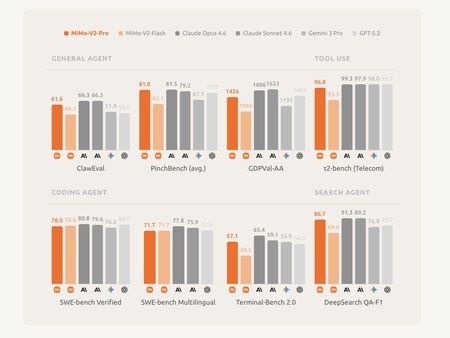
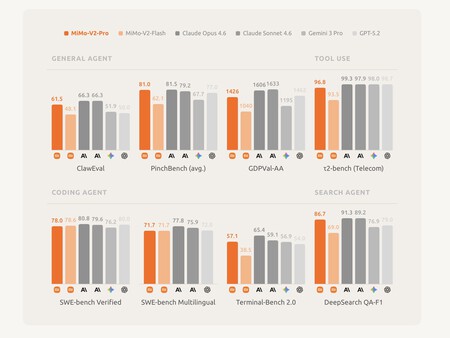
While Xiaomi does not claim its model as the undisputed leader, it asserts that the MiMo-V2-Pro can compete in specific scenarios. In the GDPval-AA benchmark, which focuses on real agent-type tasks, it achieves an Elo score of 1426, surpassing notable Chinese models like GLM-5 (1412) and Kimi K2.5 (1309). Nevertheless, it falls short of outperforming top-tier competitors such as Claude Sonnet 4.6, which scores 1633. An independent evaluation from Artificial Analysis assigns it a score of 49 on its intelligence index, placing it among the most competitive models in the market. This reflects its close performance in certain benchmarks rather than outright superiority.
The Key to the Price
This is where Xiaomi’s strategy significantly alters the competitive landscape. Data from Artificial Analysis suggests that operating the MiMo-V2-Pro model costs approximately $348, compared to $2,304 for GPT-5.2 and $2,486 for Claude Opus 4.6. While this isn’t a direct reflection of API usage rates, it does illustrate Xiaomi’s clear competitive advantage in pricing against several Western rivals. Furthermore, the company’s API prices are set at $1 per million tokens for input and $3 for output up to 256K—a rate lower than comparable models like Claude Sonnet 4.6 and Claude Opus 4.6.
Beyond Chat
The innovations presented by Xiaomi extend well beyond mere conversational improvements. The company aims to facilitate a transition from conversation to actionable tasks, introducing a system capable of utilizing tools, interacting with its environment, and executing chained tasks. To reinforce this vision, Xiaomi links its model to frameworks such as OpenClaw and reveals collaborations with OpenCode, KiloCode, Blackbox, and Cline, suggesting a focus on AI that actively engages in workflows instead of simply providing answers.

Behind the Scenes
Xiaomi’s entry into the AI market with the MiMo-V2-Pro indicates a close alignment with key benchmarks under certain scenarios, though it does not generally outperform its competitors. Its primary distinction appears to be the cost-effectiveness of its offering. The crucial question moving forward is whether this balance between cost and performance will hold true beyond benchmark scenarios and into real-world applications. Only time will reveal if these promising statistics translate effectively into practical performance.
Images | Xiaomi
In Xataka | China has immediately understood the future of the technology industry: “one-person companies” powered by AI