
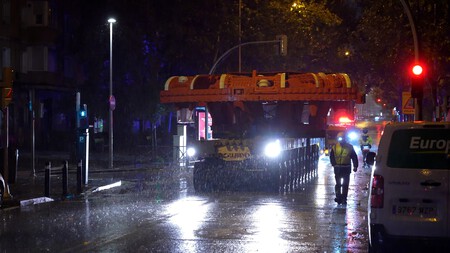
In Madrid, the enormous Mayrit tunnel boring machine has officially arrived, poised to revolutionize the city’s underground transit landscape. This impressive machine spans 98 meters in length and weighs 1,500 tons. Its journey began in Germany, traversing the Rhine to Rotterdam before boarding a vessel bound for the port of Santander. From there, a specialized convoy undertook a 450-kilometer road transport to the future Comillas station, where Mayrit will prepare to excavate a new segment of Line 11, connecting Plaza Elíptica and Conde de Casal.
The Ambitious Metro Expansion Project
The work involving Mayrit is part of an extensive initiative that the Community of Madrid touts as the largest Metro network expansion in the last decade. Current official data indicates that the project is at 34% completion, with a budget of 518 million euros dedicated to finishing the new section and its associated stations. The regional government has marked 2027 as the target year for completing this phase.
Precision Engineering: Assembling Mayrit
Assembling such a colossal machine demands extreme precision, far surpassing typical engineering processes. Mayrit’s journey began well in advance of its arrival in Madrid. Initially manufactured in Schwanau, Germany, it took approximately 20 months to complete. The first assembly of the TBM occurred in June 2025 for preliminary checks, highlighting the complexity involved in disassembling it into transportable modules.
This disassembly was meticulous, requiring two months of careful work by Herrenknecht teams. They followed a rigorously calculated sequence to separate each module, ultimately resulting in a collection of sections prepared for international transit.
The Transportation Phase
The arrival at the port of Santander signified the advent of the final leg of Mayrit’s journey. This phase involved a highly coordinated transport effort, markedly different from earlier river and maritime stages. The components were dispatched in separate shipments and transferred onto specially prepared platforms, utilizing specialized equipment to prevent any unexpected displacements during transport.
The road transport utilized large-tonnage vehicles, escorted by teams to ensure clearances, turning radii, and urban access points were properly checked. Notably, much of the movement occurred at night to minimize disruptions and enhance maneuverability through tight urban areas.
Preparing for Operation at Comillas
The arrival of Mayrit at the Comillas area heralds the commencement of assembly, where specialized personnel and equipment will configure the various modules into a fully operational tunnel boring machine. This phase is set to unfold between June and November 2025, potentially extending into March 2026. A strict order governs the assembly, involving the connection of hydraulic and electrical systems, followed by crucial testing in late January and February.
Operational Expectation and Challenges
The official specifications classify Mayrit as an EPB (Earth Pressure Balance) machine, tailored to suit the geotechnical properties of its operational layout. It operates on a principle that upholds pressure balance to prevent undesirable surface movements, especially critical in urban settings. Shifts of specialists will monitor control and evacuation systems of the excavated materials. With an anticipated performance of close to 15 meters per day, the TBM is will significantly influence the mechanized advancement rate of the project.
The Future of Madrid’s Transportation
The Comillas station will serve as the launch point for Mayrit’s excavation efforts, advancing towards Conde de Casal while parallel manual excavation work progresses towards Plaza Elíptica. This transition from preparatory work to actual excavation marks a vital phase in transforming Line 11 of Madrid’s Metro system. Each meter excavated edges the project closer to the envisioned layout, bolstering mobility in one of the city’s busiest transit corridors.
Images | Community of Madrid