
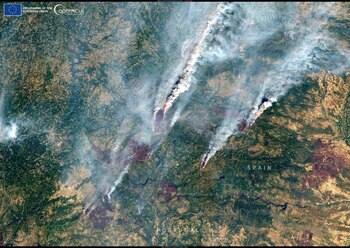
Copernicus, the European Union’s Earth observation program, recently highlighted the alarming effects of wildfires in southern Europe through a powerful image captured by its Sentinel-2 satellite on August 16 . The image displays dense smoke columns rising from active fires near Ourense in Galicia, a region known for its scenic landscapes and agricultural importance.
According to data from the Copernicus Atmospheric Monitoring Service (CAMS) , by August 17 , Spain had already registered its annual emissions from wildfires, marking a worrisome escalation in their frequency and intensity. The figures align with a 23-year data set , indicating one of the most critical fire seasons recorded. Portugal , the neighboring country, has not been spared either; its annual emissions have nearly reached the historical maxima observed in 2003 and 2005, particularly in its northern and central regions.
Impact on the Regions
The ongoing wildfires have significantly impacted both Spain and Portugal, ravaging vast areas and threatening local communities. In Spain, the drought and high temperatures have combined to create an environment conducive to fire spread , with wildfires reported across Galicia , Asturias , Castilla y León , and Extremadura . The situation has prompted urgent responses from various governmental and non-governmental organizations.
In response to the escalating crisis, the Copernicus Emergency Management Service (CEMS) has been activated. This service provides specialized emergency cartography services to support national authorities fighting wildfires. Virginia Barcones, the Director General of Civil Protection , emphasized the importance of satellite technology in assessing the situation, stating that the European Civil Protection Mechanism has requested the activation of Copernicus for fire monitoring, following a formal request from Spain’s Ministry of Interior.
Importance of Satellite Monitoring
The integration of satellite technology in monitoring wildfires serves as a crucial tool for disaster management. Real-time satellite imagery provides invaluable data that helps in assessing the extent of the fires, identifying safe evacuation routes, and orchestrating effective resource allocation. The capabilities of CEMS facilitate rapid assessments that are essential for informed decision-making during crises.
In addition to immediate response efforts, ongoing assessments are critical for understanding how such environmental factors contribute to climate change . The correlation between increasing global temperatures and wildfire frequency is becoming increasingly evident. This relationship underscores the importance of strategic planning and disaster preparedness initiatives in regions prone to wildfires.
Future Outlook
The situation currently unfolding in Spain and Portugal serves as a stark reminder of the vulnerability faced by many communities due to climate extremes. As summer progresses, it is expected that regions across southern Europe will continue to experience heightened risk for wildfires. The reliance on satellite monitoring and emergency management services will become even more critical as authorities work to adapt to these changes.
Public awareness and education about fire safety are equally essential in these circumstances. Communities on the front lines must be equipped with practical strategies for fire prevention and response, emphasizing the significance of maintaining clear vegetation around properties and developing community evacuation plans.
As Spain and Portugal grapple with the consequences of these devastating wildfires, collaboration between governments, communities, and organizations will play a crucial role in mitigating future risks. The increasing frequency of extreme weather events, driven largely by climate change, presents an ongoing challenge that requires a unified approach toward both immediate response and long-term sustainability. The photographs and data collected through Copernicus not only illustrate the current landscape but also offer critical insights for future action against the backdrop of an unsettling reality.