
The Incredible Journey of Paul Graetz: Crossing Africa in a Custom 4×4
In 1884 , the African continent underwent a dramatic transformation as European powers contested ownership over its vast lands. The Berlin Conference set the stage for the colonization of Africa, assigning territories to different nations. Among the countries involved, Germany claimed a significant portion of the continent. Although Germany lost its colonies after World War I , it gained an extraordinary legacy: being the first to demonstrate the reliability of the first 4×4 vehicles through an audacious adventure.
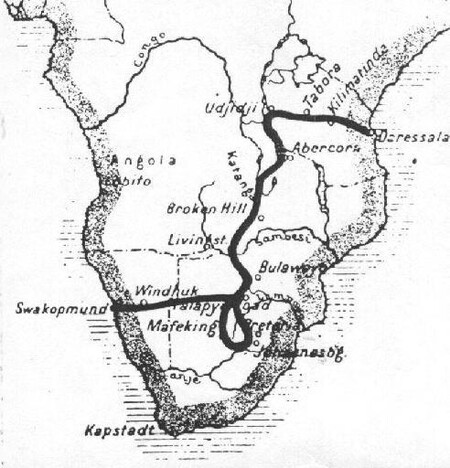
The story centers around Paul Graetz , a German officer who took it upon himself to traverse the African continent from coast to coast. His ambitious journey spanned approximately 10,000 kilometers across largely unknown territories for the automobile.
The Adventure Begins in 1907 , after serving as a lieutenant in German East Africa , Graetz returned to embark on a new quest: to devise a route connecting Dar-Es-Salam in Tanzania and Swakopmund in Namibia. This connection aimed to facilitate economic development in both territories, enhancing the benefits for the German colonies.
Graetz faced daunting obstacles as he plotted a route through mountains , deserts , jungles , and savannas , often without established roads or trails. His most formidable challenge, however, was the vehicle itself.
The Car: Graetz knew a conventional vehicle wouldn’t suffice for such a journey. In collaboration with Süddeutsche Automobil-Fabrik Gaggenau , he devised a custom vehicle tailored to the harsh conditions of Africa. By modifying an existing model, they created a machine capable of tackling the continent’s challenges.
- Custom chassis elevated by 35 centimeters for better ground clearance.
- A four-cylinder engine producing 35 hp .
- Two gas tanks: one with a capacity of 250 liters and another with 125/145 liters .
- Reinforced body for heavy loads.
- Wooden wheels with a diameter of 1,120 mm and width of 120 mm .
The wooden components, while unconventional, were representative of the technology available at the time. With a spacious interior capable of converting into a makeshift bedroom and outfitted with oil lamps, the vehicle was well-prepared for the journey ahead.
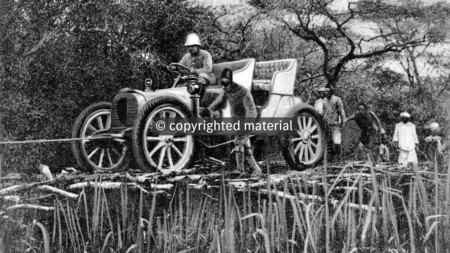
Challenges Faced: While Gaggenau provided Graetz with a commendable vehicle, numerous issues arose almost immediately. The expedition, which began on August 10, 1907 , faced sporadic rains, forcing Graetz to improvise a metal reinforcement for the wheels and rendering them stuck in the desert dunes. Fuel shortages became critical, and at one point, he even had to transport the car by boat across Lake Tanganyika .
Mechanically, the situation grew dire. With no nearby experts in colonial Germany, Graetz often had to learn to repair the engine while on the move, waiting for parts to arrive over a three-month period during a particularly challenging phase of the journey.
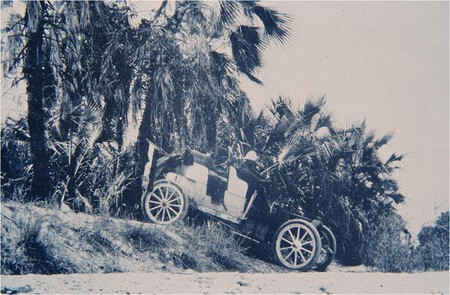
The difficult landscapes faced during the journey
Ultimately, after enduring 630 days and covering over 10,000 kilometers , Graetz and his custom 4×4 arrived in Swakopmund on May 1, 1909 . The journey attracted media attention, regarded as a triumph of engineering and industrial progress over the formidable forces of nature. Kaiser Wilhelm II even hailed Graetz with a telegram reading “Gut Gemacht, Graetz” or “good job, Graetz.”
His one-man expedition benefited from countless collaborators, showcasing the collective effort behind this remarkable achievement.
The expedition’s significance extended beyond just crossing the continent, becoming a poignant reminder of the audacious spirit of exploration. The modified vehicle has since been preserved in museums as a piece of automotive history, arguably the first true Road Trip .
Graetz’s thirst for adventure did not wane. In 1911 , just two years later, he led another expedition with the aim of navigating the Bangweulu River from Mozambique to the Atlantic. Employing a power boat, he documented the journey with a filmmaker, but tragedy struck after a buffalo attack, resulting in the filmmaker’s death and Graetz sustaining serious injuries.
Remarkably, footage from Graetz’s journey was considered “Lost Media” for nearly a century, only resurfacing in 2007 from his own home. Graetz was a born explorer, and his incredible journey continues to inspire modern adventurers. There are even tours available to retrace the steps taken by this tenacious explorer.
Images sourced from Mercedes-Benz and Paul Graetz highlight this incredible achievement, showcasing the spirit of exploration that continues to resonate today.