
It doesn’t matter if it’s a mobile phone, a laptop, the Nintendo Switch, or a Dyson: as you use it, the battery life will reduce. Yes, lithium-ion batteries have changed the world and have been the absolute standard in consumer electronics for years, but degradation over time is their endemic evil. As we look for alternatives to this technology, one research team has found a promising solution in a seemingly simple chemical tweak.
The Advance in Lithium-Ion Technology
The advance. The key idea of this research is not to alter the main materials of the battery but to introduce a small additive: lithium difluorophosphate. While this compound’s existence is not new, research led by Professor Chunsheng Wang from the University of Maryland reveals its effectiveness in stabilizing batteries.
Why This Modification Matters
Why is it important? Lithium-ion batteries are ubiquitous in our daily lives, and this modification can extend their useful life using standard, low-cost chemistry. The findings of the research indicate that with this additive, batteries can be optimized to either maximize power and energy or achieve greater longevity and stability.
Practical Implications of the Research
The study demonstrates that by adding this adjustment, batteries maintained a significantly higher capacity after hundreds of charge and discharge cycles. As Wang explains, “It is a relatively simple modification of current batteries.” This could realistically lead to improvements that consumers will see in the market soon.
Understanding Battery Mechanics
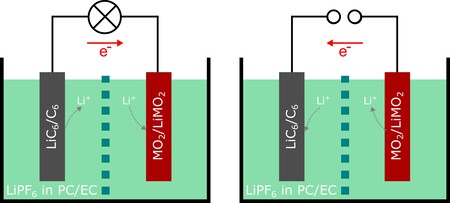
Brief notes on the mechanism of a battery. Lithium-ion batteries consist of a negative anode and a positive cathode, separated by a porous layer and immersed in an electrolyte. This assembly allows for the movement of lithium ions between the electrodes during charging and discharging.
Charging and Discharging Process
When discharging, the anode releases electrons to the electrical circuit, powering the device, and sends ions to the electrolyte, which then meet again at the cathode. Charging reverses this process, as an external source “pumps” the ions back to the anode to store energy. The depletion of capacity over time is attributed to irreversible lithium loss due to secondary chemical reactions and the mechanical fatigue of the electrodes.

Basic diagram of the operation of a lithium-ion battery. Walter Davison. Via: Wikimedia
The Role of the Solid Electrolyte Interface (SEI)
In detail. Delving deeper, we encounter the solid electrolyte interface (SEI), a thin layer that forms on the anode during the initial charges. In standard batteries, this layer is fragile and deteriorates with use, consuming lithium and negatively impacting battery longevity.
Enhancing the SEI with Chemical Adjustments
This research shows that the additive enhances the electrolyte’s ability to accept electrons, leading to more controlled degradation. It promotes a more robust, elastic, and uniform SEI, acting as a shield against parasitic reactions with the electrodes. Moreover, this flexible chemistry allows for adjustments based on protective needs, helping to reduce cracks in the cathode.
In conclusion, the modification using lithium difluorophosphate presents a viable route to enhancing lithium-ion battery longevity, which is crucial as our reliance on these batteries continues to grow.