
The Earth’s Magnetic Field: Unveiling the Mystery Beneath Our Feet
Life on Earth, as we know it, significantly hinges on the stability of the Earth’s magnetic field . However, the factors contributing to this stability are still shrouded in mystery, with some emerging from the void of outer space and others lurking thousands of kilometers beneath our feet.
From the Bottom Up: Beneath our feet lie enormous geological structures known as Large Low Velocity Provinces (LLVP) . These massive rock formations located in the mantle of the Earth could have a significant role in disrupting the magnetic field that protects our planet from harmful radiation and particles emanating from space. The term “sunk continents” refers to these LLVPs, which have a unique characteristic: they slow down the travel time of seismic waves compared to their surroundings.
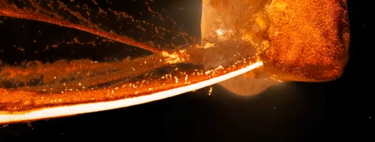
Seismologists have identified two major LLVPs: one beneath the African tectonic plate and another beneath the Pacific plate . The exact nature and origin of these ancient rock masses remain elusive, with various hypotheses vying for acceptance. One theory posits that the LLVPs might be remnants from a cosmic collision between primordial Earth and a planet-sized body known as Theia . This cataclysm is often cited as the event leading to the formation of the Moon , with parts of Theia potentially embedded in Earth’s mantle, resulting in these “lost continents.”
Another school of thought suggests that these LLVPs could partially consist of buried oceanic crust , formed through subduction processes. This theory brought forth new insights, encouraging scientists to further explore the composition and origin of these enigmatic regions.
<img alt="Virchow's impact theory: Earth and Theia collide" width="375" height="142" src="https://i.blogs.es/ec1408/choque-gaia-theia/375_142.png"/>Fed by a “Fire Ring”: Recent studies have modeled the convective movements of the Earth’s mantle, retroactively reconstructing the tectonic plate movements over the past billion years. It appears that the African LLVP is composed of older, more mixed material, while the Pacific counterpart contains approximately 50% more oceanic crust and features that are considerably younger and distinct from the surrounding mantle. These findings correlate well with the Pacific Ring of Fire , a vast network of tectonic boundaries that often recycle portions of Earth’s crust back into the mantle.
The findings were published in a study featured in *Scientific Reports* by Nature . Researchers indicate that this active geological cycle has persisted for at least 300 million years, effectively supplying material to the Pacific LLVP.
Diversity is Key: Previous assumptions suggested that both LLVPs shared a similar composition, primarily due to their effect on seismic wave velocity. New insights reveal that this may not be the case, as the different temperatures and chemical compositions of materials in these regions could lead to diverse seismic characteristics.
The Complexity of Balance: The unique placement of these LLVPs on opposite sides of the Earth provides an interesting dynamic. This geographic symmetry could facilitate the even distribution of thermal energy from the Earth’s core to its upper layers, impacting the convection currents within the planet’s core and subsequently influencing the magnetic field. However, if the LLVPs are inherently different, this symmetry could be disrupted, leading to potential imbalances in magnetic field generation.
Examining the Hypotheses: The implications of these new findings raise questions about the origin of the LLVPs. Are they remnant pieces of residual continental crust or evidence of Theia’s impact? While this recent research lends weight to the theory that these large masses could be remnants of Earth’s geological history, it does not provide conclusive evidence; nonetheless, it offers new avenues for further investigation.
In an age where the intricacies of our planet’s internal processes are slowly being unraveled, the quest to comprehend the LLVPs becomes crucial in understanding not only planetary geology but also the nature of the Earth’s magnetic field and its implications for life on our planet.
As our understanding of this topic continues to evolve, each study unveils fresh perspectives, urging us to dive deeper into the secrets that our planet harbors beneath its surface.