
A Turning Point for Public Employment in Spain: The 2025 Offer
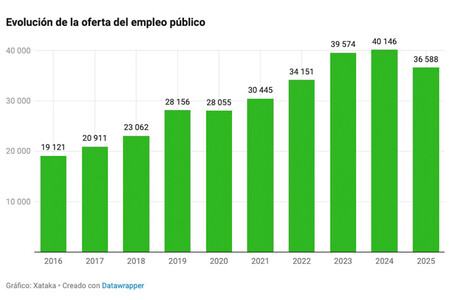
In recent years, the Pedro Sánchez government has made significant strides in promoting public employment, breaking historical records for job openings. However, the new Public Employment Offer (OPE) for 2025 presents a stark contrast, marking a critical turning point that raises concerns about staffing levels in Spain’s public sector.
The New Public Employment Offer for 2025
The recently disclosed OPE provides for a total of 36,588 new positions, indicating a 9% reduction from the previous year’s offer of 40,146 places. This decrease primarily affects the General State Administration, which will see a decline of 4,500 new positions, now totaling 26,889. This shift reveals a troubling trend, particularly when contrasted with past years where public employment offers were consistently labeled as “historical” due to their substantial volumes.
The Independent Trade Union and Officials (CSIF) have voiced concerns, asserting that “the places are insufficient to cover the losses accumulated in the administration of the State in recent years.” They also point out the negative impact of absent new budgets and freezes on European Union funds, which are already evident in this latest call.
Distribution of Available Positions and Personnel Shortages
The distribution of positions within the OPE for 2025 shows that certain sectors will receive an infusion of personnel. For instance, the State Security Forces and Bodies are slated for reinforcement, with the National Police Corps gaining 3,139 new positions, a rise of 300 from the previous year. The Civil Guard will add 555, bringing their total to 3,713 new positions, while the Army is expected to incorporate 2,847 new troops, an increase of 200 from last year.
In terms of the Central Administration, the new offer includes 20,324 new positions for open access, alongside 6,565 internal promotion slots. Notably, of the new open positions, 8,851 are allocated to enhance citizen services, covering various essential offices such as the SEPE (Public Employment Service), as well as departments handling foreign matters, cadastre, issuance of national identity documents (DNI), traffic (DGT), social security, or tax agency services.
Addressing the Challenge of Generational Relief
Since the current government took office at La Moncloa, it has summoned an impressive 260,000 public employment positions. As highlighted by Minister Óscar López during the OPE 2025 presentation, this results in an average of 32,522 annual public positions. Despite these efforts, substantial structural employment needs within the public sector remain unmet.
The Active Population Survey (EPA) data from the first quarter of 2025 reveals a troubling trend: public employment has recorded a decline of 51,900 individuals in its workforce for the first time since 2018. While these offers aim to address accumulated losses, the overall balance continues to be negative.
A pressing concern for the administration is the impending retirements expected over the next decade. According to a study on workforce aging in the General State Administration for 2024, 59.95% of the workforce is over 55 years old. This aging demographic necessitates the recruitment of new staff to fill positions vacated by retiring employees. For instance, in 2023, the number of retirements reached 10,758 officials, while only 8,770 new officials were recruited, leading to a deficit of nearly 1,988 positions that went unfilled that year.
Comparative Employment Status
Examining Spain’s public employment landscape reveals concerning statistics. According to the OECD’s ‘Government at a Glance 2025’ report, public employment in Spain constituted 15.25% of the total active population in 2023, falling below the OECD average of 18.41%.
Moreover, despite an increase in the number of positions, public employment growth in Spain has not kept pace with private employment growth, failing to mirror the efforts observed in other nations where public sector expansion plays a crucial role in maintaining essential services.
In light of these developments, it becomes clear that the Spanish public employment landscape is at a crossroads. While offers have increased in recent years, this latest reduction signals urgent needs that must be addressed. The challenges of replacing retirees and ensuring adequate staffing levels are paramount for efficiency and effectiveness in public service. As the government moves forward, focusing on these issues will be critical to fulfilling the needs of a dynamic populace reliant on public services.