
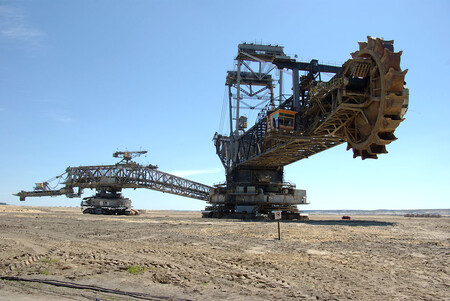
In North Rhine-Westphalia, western Germany, a colossal machine, unlike any other built by humans, tirelessly operates in the extractive processes of coal mining. This behemoth is known as Bagger 293, a testament to the heights of industrial engineering, primarily designed for open-pit mining.
What is Bagger 293?
Bagger 293, also recognized as the MAN TAKRAF RB293, is a bucket-wheel excavator that dramatically reshapes the landscape. Constructed by TAKRAF, a subsidiary of the MAN group, between 1990 and 1995 in Leipzig, its primary purpose has always been the extraction of lignite, commonly referred to as brown coal, from the Hambach mine—one of the largest mining operations across Europe. Owned today by RWE Power AG, Germany’s second-largest energy producer, this machine continues to play a pivotal role in energy generation.
Staggering Dimensions
: Bagger 293 stands at an astonishing height of 96 meters—equivalent to over 30 floors—and stretches 225 meters long, more than the length of two football fields placed end to end. Weighing in at an incredible 14,200 tons, it holds the Guinness World Record as the largest and heaviest land vehicle on earth, a title it shares with its predecessor, Bagger 288. However, Bagger 293 eclipses it in both size and operational capacity.
Operation and Efficiency
Transferring Bagger 293 itself is no simple feat. Moving the machine a mere 120 kilometers necessitates over three weeks of continuous work, with progress of only 5 to 6 kilometers per day. Its mechanics are equally impressive. The core element of the Bagger 293 is an enormous rotating wheel, 21.3 meters in diameter, equipped with 18 large steel buckets. Each bucket can handle up to 15 cubic meters of earth per cycle, allowing Bagger 293 to excavate a staggering 240,000 tons of material daily—equivalent to the labor of approximately 40,000 miners, all managed by just five operators from a centralized cockpit.
Power Consumption
To function effectively, Bagger 293 requires a substantial external energy supply of about 16.56 megawatts (over 22,500 HP)—enough to power a city of about 20,000 residents. Notably, it lacks a traditional engine; instead, it remains permanently connected to an industrial electrical network. Its 12 steel tracks, each spanning 3.8 meters wide, help distribute its immense weight across the ground to prevent sinking.
The Hambach Mine
Operating in the Hambach mine, Germany’s largest open-pit mining site, Bagger 293 plays a crucial role. The mine spans 8,500 hectares and plunges 500 meters below ground level, producing around 40 million tons of lignite annually—sufficient for approximately 8 million homes. However, this mining operation is not without controversy. Brown coal is one of the most polluting fossil fuels, and the extraction process has decimated about 90% of the historic Hambach Forest, an ecosystem over 12,000 years old.
Since 2012, environmental activists have made headlines by occupying the remaining trees, igniting a debate about climate issues in Germany. The situation reached a tipping point when a large-scale protest against the mine’s expansion occurred in 2018, a movement that captured international attention, especially after Greta Thunberg visited in 2019 and described the scene as “devastating.” Following continued activism, the German government pledged to preserve the remaining forest and commit to a coal exit by 2038.
Future Outlook
According to Global Energy Monitor, coal mining at the Hambach site is set to cease by 2029, with plans to transform the land into an eco-friendly landscape featuring a large artificial lake.
Images | Andreas Lippold (Wikimedia Commons), Stefan Fussan (Wikimedia Commons), Steve Rowell