
The Emergence of the Japanese Railgun: An Innovative Military Advancement
In a significant development for military technology, the Japanese Railgun has physically been integrated into the JS Asuka, a ship that serves as a testing ground for new technological advancements. Recent images, taken from the port of Yokosuka, showcase the railgun without its external housing, indicating it is in its final stages of preparation before potential sea trials. The timeline for these tests appears imminent, though official confirmation remains pending.
Images shared by user @Gov_vessel_fan depict the cannon in an exposed state, devoid of the protective cover typically used to conceal it. This prototype aligns closely with designs tested previously by the Agreement, Technology and Logistics Agency (ATLA) of the Japanese Ministry of Defense. While it is uncertain whether significant design changes have been implemented, its appearance matches that which ATLA has previously showcased publicly.
Challenges and Innovations: Speed and Wear
One of the primary challenges faced by railguns is the extreme wear associated with their operation. The rapid friction resulting from firing high-speed projectiles leads to a swift deterioration of the barrel, significantly compromising both precision and range. According to findings from Naval News, earlier trials with the Japanese prototype have successfully reached speeds of up to 2,000 meters per second , boasting a relatively short lifespan due to the wear on the cannon’s barrel, which is reported to seamlessly accommodate approximately 120 projectiles .
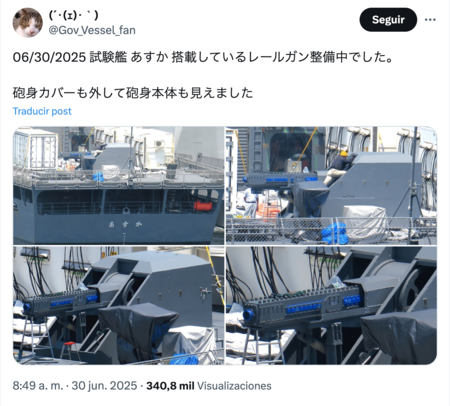
Click to see the publication in x
The installation of a railgun involves much more than simply creating space within a vessel. These advanced weapons necessitate an immense supply of energy and effective cooling systems to manage the considerable heat generated during operation. The JS Asuka , with its expansive rear compartment and designated role as a testing platform, is ideally suited for this complex integration phase.
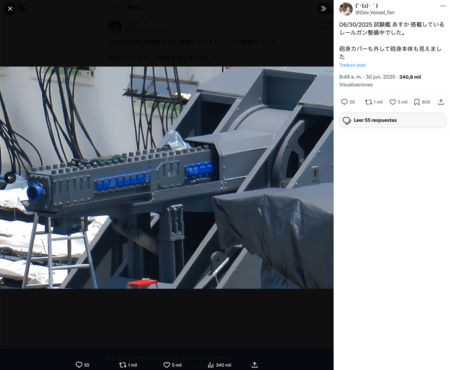
Click to see the publication in x
Despite the current prototype’s somewhat clunky appearance, the Japanese Ministry of Defense harbors more ambitious objectives . During the DSEI Japan 2025 fair, authorities unveiled a more streamlined model of the weapon, designed with operational deployment in mind.
According to National Defense Magazine, Kazumi Ito, the director of ATLA’s Equipment Policies Division, noted that development is making progress but acknowledged the presence of “various challenges.” The clear intention going forward is to successfully integrate this groundbreaking technology into next-generation destroyers.

While the United States Navy previously led efforts to develop railguns, the program was officially abandoned in 2022 due to multiple delays and technical setbacks. Unlike the U.S., which refrained from advanced testing, Japan has decided to persist in exploring this cutting-edge technology, collaborating closely with the United States to overcome the challenges ahead.
Images | Maritime Self-Defense Force of Japan | @Gov_vessel_fan
As advancements in military technology continue to evolve at a rapid pace, the developments surrounding the Japanese railgun offer insight into the future of naval warfare. With ongoing research and testing, the potential for railguns could redefine traditional combat strategies, emphasizing speed, precision, and technological prowess.