
James Webb Telescope: Unveiling Interstellar Composition
With each interstellar object that approaches Earth, excitement ripples through the scientific community and beyond. While some greet these visitors as harbingers of new knowledge about distant planetary systems, others harbor concerns about potential extraterrestrial technology. Notably, interstellar bodies like ‘Oumuamua in 2017 and 2I/Borisov in 2019 generated considerable interest, but the recent encounter with comet 3I/ATLAS has taken the spotlight due to groundbreaking observations made by the James Webb Space Telescope (JWST).
The Breakthrough Analysis
Recent studies confirm that the JWST, leveraging its versatile tools, has successfully analyzed the chemical fingerprints of an interstellar object for the first time. Utilizing the MIRI (Mid-Infrared Instrument) spectrograph, the telescope examined 3I/ATLAS’s unique composition. Different chemicals interact with light in distinct ways, enabling scientists to decode the spectral data and identify various gases.
Uncommon Gases Detected
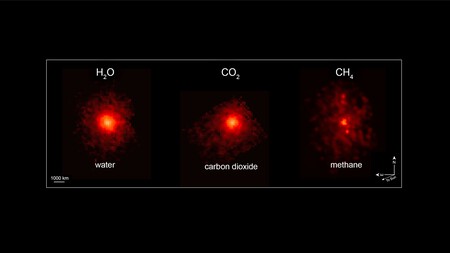
Intriguingly, water vapor was discovered beyond the nucleus of 3I/ATLAS, likely a result of melting ice grains within the comet. More strikingly, methane and carbon dioxide were identified in close proximity to its core—the first time methane has ever been detected in an interstellar visitor. Notably, the quantities of these gases are disproportionately high compared to typical comets in our solar system, suggesting that this comet originated from a vastly different region.
MIRI reveals the chemical makeup of 3I/ATLAS across three wavelengths, pinpointing gas locations during observations.
Key Observation Periods
The JWST conducted its measurements of 3I/ATLAS on two significant occasions: from December 15 to 16, 2025, and again on December 27, 2025, as the comet started its return journey after orbiting the Sun.
The Sun’s Catalyst Effect
Previous attempts to discern the gases present in 3I/ATLAS faced challenges, with methane remaining undetected until the recent observations. The authors suggest that this gas likely lay buried within ice until solar heating triggered its release.
Ongoing Exploration
The approach of comet 3I/ATLAS attracted diverse scientific attention, with multiple instruments eager to collect data. The JUICE probe, deployed by the European Space Agency, was ideally situated to capture information prior to its launch for exploring Jupiter’s icy moons. Data from this probe was relayed to Earth in February 2026, and the analysis is poised to yield further insights in the time to come.
Conclusion: A New Era of Discovery
The data gleaned from 3I/ATLAS signifies just the beginning of our interstellar exploration. While the comet has long departed, the excitement and scientific inquiry it ignited remain. As we continue to analyze and learn from these celestial visitors, the merging of astronomy and cutting-edge technology opens limitless possibilities for understanding the cosmos.