
The Unyielding Cost of War: Understanding the Economic Fallout of the Russia-Ukraine Conflict
The video game ‘Fallout 3’ famously opens with, “War… war never changes.” However, the ongoing conflict between Russia and Ukraine has demonstrated that while the essence of war may remain constant, the strategies and technologies evolve rapidly, particularly in the age of drones . This conflict has set the stage for new tensions worldwide, notably between Iran and Israel . Nonetheless, what remains unchanged is the devastation and economic cost that war inflicts on nations and their people.
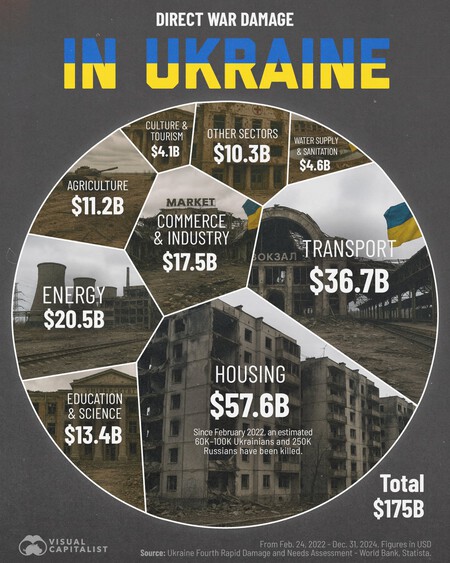
To grasp the economic impact of the war in Ukraine, a powerful representation is found in this chart:
According to an analysis by Visual Capitalist, the World Bank’s Rapid Damage and Needs Assessment reveals staggering figures. As of December 2023, total verified destruction in Ukraine amounts to over $175 billion . The breakdown shows that the conflict has severely impacted various sectors, with some sectors essential to daily life taking the brunt of the damage.
Among the most affected sectors are housing and transportation infrastructure. Together, these account for over half of the total damage. Notably, it is estimated that one in eight homes in Ukraine has been either damaged or destroyed, necessitating around $57 billion for reconstruction efforts. This dire situation speaks volumes about the human cost of conflict.
Furthermore, damage to roads , bridges , and railways is appraised at approximately $37 billion . These essential infrastructures are pivotal for mobility and logistics, adding further complications to recovery efforts.

Energy infrastructure is yet another critical casualty of this war. With damages estimated at over $20 billion , energy facilities have taken a significant hit. Although Ukraine is connected to the European Emergency Electric Network , the war has resulted in frequent blackouts affecting both homes and businesses. It’s worth noting that Ukraine hosts Europe’s largest nuclear power plant—although its operational status is now uncertain due to ongoing conflict.
The ripple effects of housing and transport damage are profound, as they exacerbate the displacement crisis. Many individuals are forced to flee to other cities where rental properties are available, often driving rental prices beyond the reach of regular citizens due to the law of supply and demand. Additionally, the impaired transport infrastructure severely limits the transportation of not only citizens but also essential goods, such as grain and metals, which are vital for Ukraine’s economy.
Looking beyond these primary sectors, numerous other components have suffered damages below the $20 billion mark, including:
- Commerce and Industry – $17.5 billion
- Education and Science – $13.4 billion
- Agriculture – $11.2 billion
- Water Supply Networks – $4.6 billion
- Culture and Tourism – $4.1 billion
Furthermore, an additional $10.3 billion has been reported in damages across other sectors, all of which are intricately linked.
As we analyze the devastation, it is crucial to acknowledge that these figures reflect just the direct costs of verified physical damage. The total cost for recovery is projected to be an astronomical $524 billion . According to the World Bank , this amount is essential for rehabilitation efforts over the next decade, assuming the conflict reaches an eventual conclusion.
This staggering figure represents nearly three times the projected nominal GDP of Ukraine in 2024. The cost of debris management alone will require around $13 billion . The anticipated breakdown for recovery is instructive:
- Housing – $84 billion
- Transport – $78 billion
- Energy and Mining – $68 billion
- Commerce and Industry – $64 billion
- Agriculture – $55 billion
These estimates are contingent upon the expected end of fighting, a development that remains uncertain. It’s also critical to not overlook the human cost , which is irreplaceable. It is estimated that Ukraine has suffered military losses ranging from 60,000 to 100,000 personnel , while reports suggest that up to 250,000 Russian soldiers have perished in combat as well. The brutal reality of this war underscores the need for understanding, reconciliation, and a way forward that prioritizes human dignity and recovery.