
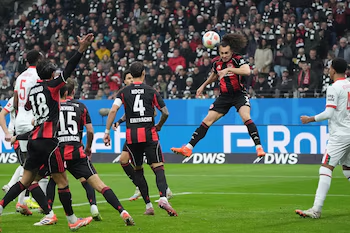
Financial Impacts of Pyrotechnics in German Football
FC Köln made headlines during the 2024/25 German football season as one of the most penalized clubs, with fines exceeding 900,000 euros for the use of banned pyrotechnics in stadiums. The German Football Federation (DFB) reported that the total fines imposed across clubs reached 12 million euros, representing a slight decrease from the previous season’s 12.5 million euros.
The Breakdown of Fines Across Clubs
The DFB highlighted that the predominant cause of financial penalties in German professional men’s football stemmed from the use of pyrotechnic devices, explicitly prohibited within sports venues. FC Köln led the pack with a staggering 924,355 euros in fines, followed closely by Eintracht Frankfurt at 764,600 euros and Hamburger SV at 623,555 euros. Interestingly, the third division experienced an uptick in sanctions, with fines increasing from 1.5 million to 2.24 million euros.
Dynamo Dresden emerged as a significant offender in the third division, incurring a fine of 428,460 euros. This increment reflects a growing concern regarding fan behavior, especially in lower-tier leagues.
Utilization of Fine Revenue for Preventive Measures
An interesting aspect of the DFB’s penalty framework is how fines are allocated. Although the sum of 12 million euros was reported as initial revenue, clubs can use a portion for preventive measures aimed at reducing violence in stadiums. Consequently, the DFB received around 8 million euros after this provision.
Out of the total, 6 million euros were reinvested into football foundations, targeting initiatives to improve safety and behavioral standards within sports venues. This balanced approach seeks to combine financial penalties with a proactive strategy for enhancing the football environment.
Commitment to Safety and Security
The financial repercussions predominantly target clubs whose supporters engage in the use of pyrotechnics, underlining the German sports authorities’ commitment to eliminating dangerous practices in stadiums. The DFB noted a reduction in incidents among Bundesliga and second-division clubs, even as the third division experienced a surge in violations.
Regulatory Framework and Future Implications
Germany’s regulations explicitly ban the use of pyrotechnic materials, emphasizing the risks these pose to attendees and the integrity of matches. The DFB has made it clear that repeated offenders could face escalating penalties and additional restrictions in subsequent seasons, reinforcing the importance of compliance.
The strategy of reinvesting fines into preventative and educational programs aims to foster a safer football atmosphere. With the 2024/25 season highlighting ongoing challenges related to pyrotechnics, the DFB remains committed to a transparent approach, balancing punitive and preventive measures to ensure a secure and enjoyable experience for all football fans.