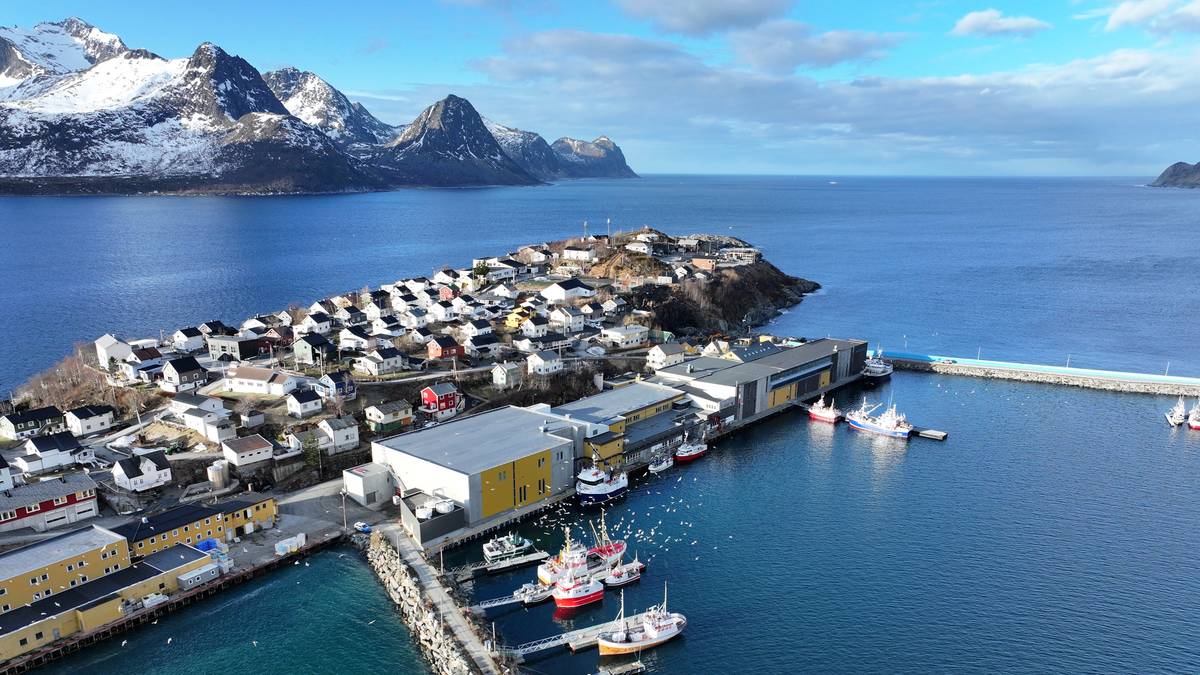
– The power situation is precarious. We need to find alternative solutions to everything we need to do. This is stated by the CEO of the Seafood Group Brødrene Karlsen, Rita Karlsen. They often experience capacity shortages in the mains. – Suddenly we have a hundred tonnes of fish inside the premises and are free of electricity. It causes expensive million class losses. Managing Director of Br. Karlsen at Husøy in Senja municipality, Rita Karlsen. Photo: Malin Straumsnes / news at Husøy in Senja municipality runs Karlsen fish reception and processes seafood. They have recently used a new production facility for around 200 million for receiving whitefish. A plant that will make it possible to operate more environmentally friendly was the goal. Photo: Malin Straumsnes / news To get power to it, they had to enter into an agreement on terms. The reason is that there is a lack of power in the north. The agreement they have with the electricity company in the area, inherited, is that they cut the current by over -consumption in the area. It was predicted that it should happen 1.5 times a day. There have been fewer power cuts than that, but still: – We thought it was going to be cut. But it happens almost daily, and sometimes several times a day. Then it became imperative to buy the unit to keep the factory going. The green, new factory often has to get electricity supplemented from this diesel unit. Photo: Malin Straumsnes / news believes the power policy is district -hostile around the same time that the diesel gard was purchased, came the OAG with criticism of Norwegian power policy. Over time, the fishing industry at Senja has felt that the power policy is district -hostile. The companies have to pay construction grants to connect new factories to the power grid. There must also be companies in cities. These are construction grants The network companies must determine construction contributions to cover the costs of new network investments and network reinforcements when customers; Getting connected, getting increased capacity, or getting better quality. The grid companies shall determine and require construction grants to cover all or part of the costs of new grid connections or by reinforcing the network of existing customers. In addition, the grid company must determine construction grants when the customer requests increased quality. Facts: The Norwegian Water Resources and Energy Directorate, but the expense for the new establishments quickly becomes much more expensive due to large distances in the districts. – The requirements for construction grants are beyond high. It is four to six times higher than comparable projects in cities. It makes no one willing to pay for it. We feel excluded. This is stated by Egil Johansen from Nord-Senja Fisk in Botnhamn. Aleksander Uteng in the seafood cluster Senja, Senja Mayor Geir-Inge Sivertsen (H) and general manager of Nord-Senja Fisk, Egil Johansen. Photo: Malin Straumsnes / news He receives support from the CEO of the Seafood Clever Senja, Alexander Uteng. He says the green shift can contribute to a doubling in electricity use in the seafood industry over the next seven years. – It is urgent with measures that allow us to expand enough power grids. And on conditions that are competitive for companies in the district, he says. The local boats at Senja are rare, if not never, electric boats. Photo: Malin Straumsnes / news The OAG: Strømsang in large parts of the country for the first time in a long time now the companies at Senja are seeing a hope of change. They believe the OAG’s criticism shows that the situation must be changed. – We are concerned that we should follow up the state ambitions to have activity throughout the country. If we are to get it, we have to have a stocking policy that is not as centralizing as today, says Uteng. Causes of the power crisis at Senja Nord-Senja need three times as much power capacity as they have today. A new streamline is being planned, but it can take 2030 before it is completed. The power requirement is great for energy -intensive new start -ups for fishing facilities. news has previously mentioned that Nergård Fisk Dag uses 12 million kWh, which corresponds to the power consumption of 600 households. A factory they missed would have had a consumption of 5 megawatts annually. The power supply is so deficient that there is not enough capacity to establish new fast charging stations for electric cars on the North Senja. There is only one public fast charging station there. It is not only on Senja the power situation is precarious. The OAG’s report shows that the current is fully booked in large parts of the country. It also points to: The Ministry of Energy has not made the necessary changes in instruments or measures to ensure adequate capacity. The total regulation and control of Statnett and the grid companies preclude investments. In the red dot areas, customers do not get to reserve electricity capacity for larger consumption. Yellow dot means that Statnett can assess it whether the available power capacity is large enough or not. Green dot means that there is still capacity in the mains. The map is from the OAG’s report. Photo: Statnett The ministry acknowledges streams Secretary of the Ministry of Energy, Elisabeth Sæther (Ap), writes in an e-mail that they agree that it has been invested too little and too late in the mains. – We are well in the process of implementing measures for faster grid development and better utilization. We see that it produces results – the licensing queues for grid systems are on the way down, she says. The Secretary of State does not share the industry players in Senja’s opinion that the power policy and construction contributions can be district -hostile. State Secretary in the Ministry of Energy, Elisabeth Sæther (Ap). Photo: Sunniva Linjord / news She emphasizes that it is expensive to build power grids. – I think it is the right principle that customers who trigger online investments also pay their share of the investments. I do not agree that Norwegian energy policy is centralizing in itself. The construction contribution regulations help to highlight where it is rational to establish power -intensive businesses without excessive grid investments. It is not always in central areas. Photo: Hans L. Andreassen / news Ask politicians to change the power policy back in the district, expectations are high. The business community at Senja hopes that the power problem will be the theme in the election campaign. – If you want a living coast, they have to do something. We do not have back to pay for the construction contributions, says Rita Karlsen at Husøy. – There is really a need for the parliamentary politicians to get on the field. We do not have electricity for the green shift, Egil Johansen adds. The streamlines that go to Husøya today went less electricity than the fishing company needs. Photo: Malin Straumsnes / news The mayor from the Right agrees. – The OAG was clear and clear, we do not have a well -functioning power policy. We must do something about that, says Senja Mayor Geir-Inge Sivertsen (H). The director who had to buy diesel gates believes it is a paradox that power shortages stop the fishing group from being environmentally friendly. – We took down the power consumption as much as possible and wanted to make the factory green. Now we have a diesel unit that stands to slam, says Rita Karlsen. Published 27.04.2025, at. 20.51
ttn-69