
On paper, the Digital Kit appears to be a promising initiative. The government’s proposal, managed by Red.es, offers a series of subsidies aimed at facilitating the “digital transformation” of SMEs and freelancers.
Essentially, this means that small businesses and self-employed individuals can, for example, establish their own website, set up an online store, and even gain access to the subsidy for a MacBook Air M4 that seems “free.”
However, the reality is far from free.
Subsidies for Digital Transformation
Promoted by Red.es and the Ministry for Digital Transformation and Public Function, this program seeks to “digitize” SMEs to help them adapt to modern demands.
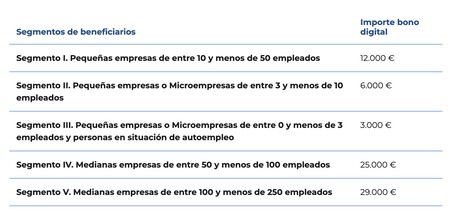
Source: Red.es
The funding is sourced from the Next Generation EU program of the European Union. Various beneficiary categories were established based on the size of the SMEs or whether the individual was self-employed.
Most segments have seen their calls come to an end in recent months, but segment III, aimed at SMEs with up to three employees and self-employed individuals, remains open.
The maximum subsidy for this category is €3,000, split into two parts. The first component offers up to €2,000 for the development of a website or an online store, while the second is a trending topic on social media—subsidies of up to €1,000 for the acquisition of a “secure job,” typically a PC or laptop. Notably, you can’t merely ask for the computer; it must be requested alongside the website or online store subsidy.
To access the program and secure those digital vouchers worth up to €3,000, the procedure—laid out in a PDF—is supposedly straightforward. Users should visit accelerapyme.es, fill out a “self-diagnosis test,” and apply for digital kit assistance through the form on Red.es electronic headquarters.

Next, applicants will have to contact a “digitizing agent,” who will serve as the intermediary for this “digital transformation.” These agents provide services (or manage third parties to do so) and handle the acquisition of the €1,000 laptop.
It’s also possible to become one of these digitizing agents by using the Red.es Electronic Headquarters, with another guide explaining the login process in a PDF.
A Digitizing Agent Tells Us About the Reality of the Digital Kit Program
While everything seems well-structured on paper, in practice, the Digital Kit program has sparked controversies affecting both applicants and those managing them.
To gain insight into the situation, we interviewed Pablo F. Iglesias, founder of the consultancy Cyberbainers, which has achieved homologation for the Digital Kit. He has experienced the “fine print” of this project, as has a service provider and a person who requested the subsidies.
After providing services for some time, he shares his perception that “too many individuals have seen the program as a quick business opportunity.” This sentiment is echoed by Jaime Gómez-Obregón, who explained on social media how a microenterprise “sold” hundreds of Digital Kit projects by subcontracting websites to freelancers in South America, thereby promoting “disposable business models.”
Iglesias also pointed out that larger companies have utilized the program to capture new customers as part of their service offerings, leading to mostly negative impacts.

Numerous complaints have emerged on social media regarding scams tied to the program. Often, websites or online stores created through the subsidy were subpar, sometimes mere “clones” of existing sites with minimal alterations that did not justify the €2,000 subsidy.
“Even if they grant, for example, €6,000 to your company, the categories are limited to maximum expenses, which often are insufficient to ensure high-quality service for a period of twelve months, leading to low-quality outputs.”
Iglesias himself pointed out that receiving €2,000 makes it nearly impossible for someone to deliver a professional website along with essential services like backups, maintenance, and monthly SEO for twelve months.
He emphasizes that this program has resulted in a surge of “supposed marketing agencies that specialize in creating cloned WordPress sites using free templates in a day’s work, all financed via the Digital Kit.” While these sites may not perform well against competitors, they seem compliant with program standards.
The Free Laptop Myth
Lately, social media platforms like TikTok have seen abundant posts featuring claims about easily obtaining a MacBook Air M4 “for free” thanks to the Digital Kit subsidies.
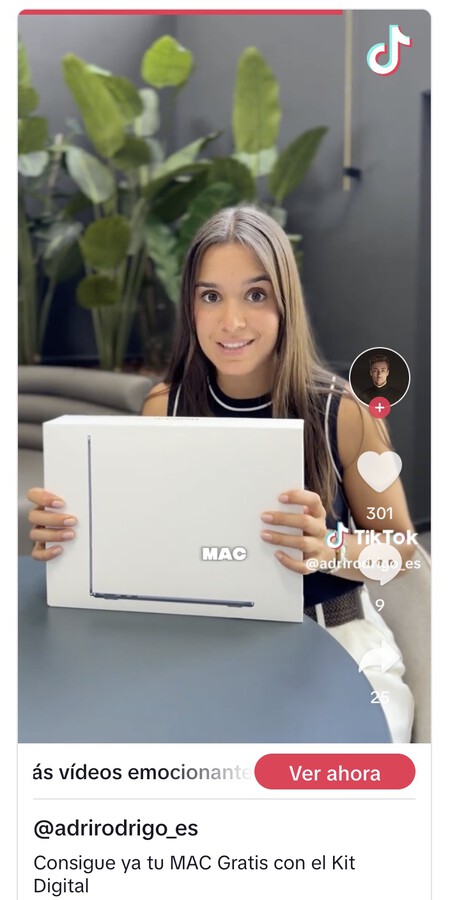

However, these claims are often misleading. While the Digital Kit program subsidizes these devices, those interested should be aware of the fine print.
Firstly, the subsidy does not cover VAT, and Iglesias points out that “the state always profits.” To acquire the laptop, applicants must request both the €1,000 subsidy for the “secure job” and the €2,000 for website creation or a digital billing system.
Moreover, agencies promoting the Digital Kit often overlook VAT charges applicable to certain regions, such as the Canary Islands, meaning applicants could bear an additional tax burden of VAT.
This means those utilizing a €3,000 subsidy will also need to account for 21% VAT, totaling €630. In the end, all of this implies that obtaining the laptop isn’t as straightforward as it seems.
If purchasers wish to “buy” the MacBook, they may end up leasing it. The digitizing agent manages the twelve-month leasing arrangement, and should you choose to keep the laptop afterward, you must pay 15% of its value as an assignment cost along with applicable VAT—an additional €181.50.

When we calculate the “free” MacBook Air M4, priced at €1,199 for its basic 13-inch version, 16 GB of memory, and 256 GB of SSD, we find that it exceeds the subsidy cap. This means that the applicant or business must cover the difference. Calculating the expenses:
- MacBook Air 13″ M4: €1,199.
- User pays €199, the difference with the maximum subsidy of €1,000.
- User pays VAT of €630.
- After twelve months, to keep the laptop, the cost would be €181.50.
In total, the user has effectively paid €1,010.50 to keep the laptop after twelve months.
Some argue this expense can be justified as a business deduction, theoretically allowing reduced VAT obligations.
A Round Business (But Probably Not for You)
As explained in Declarando, these deductions appear in quarterly statements (model 303); however, this doesn’t guarantee the Treasury will reimburse these amounts promptly.
While it’s possible to offset it with VAT from your income, you will still be paying at least €380.50 for the laptop, making it an expense rather than a “free” gift. According to Iglesias, this is a “bestial” tactic by politicians:
“Thanks to this, the State has been ‘invoicing’ millions with VAT, while digital agents are often paid late, with funds that don’t actually originate from the Spanish state but from Europe.”
This entrepreneur recounts his experience of being both a digitizing agent and a victim of potential fraud. His partner, who is self-employed, applied for the Digital Kit through a company that misused their data to claim the subsidies, but no services were provided. Upon reporting this to Accelerapyme, the outcome was closure of the contract, leaving them unable to access hardware options.
While the Digital Kit may indeed help some SMEs and self-employed individuals establish an online presence, as highlighted by the Chamber of Commerce of Spain and Red.es in their success stories, caution is essential. Always verify providers, guarantees, and the genuine costs associated with these subsidies, which often come with strings attached.