
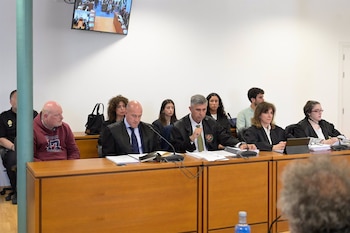
The Prosecution claims that Roger Serafín Rodríguez, the confessed murderer of Elisa Abruñedo, understood the gravity of his actions. Abruñedo, a resident of Lavandeira in Cabanas, A Coruña, was brutally assaulted and killed in September 2013 during a walk near her home. During proceedings before the Provincial Court of A Coruña, prosecutors emphasized that Rodríguez “knew what he was doing and wanted to do it.” He has, however, remained silent, refusing to testify.
In defense of Rodríguez, his lawyer called for a “fair judgment,” arguing that there was a “disassociation from reality” on his client’s part, suggesting that he believed another individual was responsible for the crime. The prosecution counters that Rodríguez was fully aware of his actions.
Brutality of the Crime
The prosecution detailed the heinous nature of the attack, asserting that the victim “could not defend herself.” Rodríguez allegedly assaulted Abruñedo sexually and then stabbed her repeatedly, inflicting fatal wounds. In a statement, the prosecutor noted, “For over ten years he said nothing, boasting that they would never find him.” The investigation, initially hampered due to a lack of DNA matches, found success when a sample from Rodríguez was ultimately analyzed.
Aggravating Circumstances
The victim’s family attorneys emphasized the “selective memory” of the defendant and pointed to the fact that he led a “normal life” for over a decade without confessing. One attorney remarked, “Besides hitting and maltreating her with disproportionate force, leaving the victim helpless, he dragged her.” They pressed for aggravating factors such as premeditation and cruelty, seeking a total of 37 years in prison for charges of sexual assault and murder, while the prosecution has requested 32 years.
During their arguments, the prosecution highlighted that the crime took advantage of the environment and timing, given that it occurred when the accused had just returned from a hunting trip. “He dragged her 17 meters into thick vegetation,” stated one lawyer, highlighting the premeditated nature of the assault and the deliberate suffering inflicted. They called for the classification of the crime as aggravated due to gender violence.
Defense Arguments
Rodríguez’s defense maintains that the acts constituted a crime of sexual assault and homicide, urging the jury to deliver a “just conviction.” They noted that the incident occurred in “daylight” in a bustling area, disputing some of the aggravating factors posited by the prosecution. Claiming a “disassociation from reality,” the defense insisted that Rodríguez believed someone else committed the crime.
Detention and Arrest Details
As of October 2023, Rodríguez has been imprisoned after being arrested by the Civil Guard at his workplace at Navantia Ferrol shipyard, where he was an employee. Post-arrest, he confessed responsibility for the assault and murder of the victim, who was part of the Eume locality.
According to the indictment, on the night of September 1, 2013, Rodríguez noticed Abruñedo walking along the provincial road DP-1503 near her home. He subsequently parked his vehicle and approached her from behind, seizing her and striking her in the face. He then dragged her off the roadway into a secluded area covered with pines and thick brush.
In this isolated setting, Rodríguez proceeded to assault and ultimately stab Abruñedo multiple times. After the attack, he fled, leaving her to die as he escaped through the underbrush to his car, where he drove away from the scene.
Proposed Sentences
The prosecution is seeking a total of 12 years for the sexual assault and an additional 20 years for murder, also demanding €200,000 in damages—€100,000 for each of Abruñedo’s children. Conversely, the family attorneys have escalated the murder charge to 25 years and are pursuing a larger compensation of €300,000 for every child.
After the trial, the defense attorney explained that the defendant’s choice not to testify stemmed from a desire to avoid revisiting the traumatic events that both he and Abruñedo’s family experienced. The prosecution, on the other hand, expressed disbelief at Rodríguez’s claim of “disassociation from reality,” suggesting he was fabricating excuses to evade punishment.