
Understanding the Global Oil Landscape
Humanity remains deeply entwined with oil. Despite the increasing emphasis on renewable energies , fossil fuels continue to play a crucial role, especially during energy peaks. Recent geopolitical tensions have compelled oil companies—once champions of renewable alternatives—to revert to their foundational business. It is important to identify which countries are endowed with significant oil reserves and how those reserves influence global economics.
The oil landscape is aptly depicted through insightful data, illustrating the reserves that countries hold.
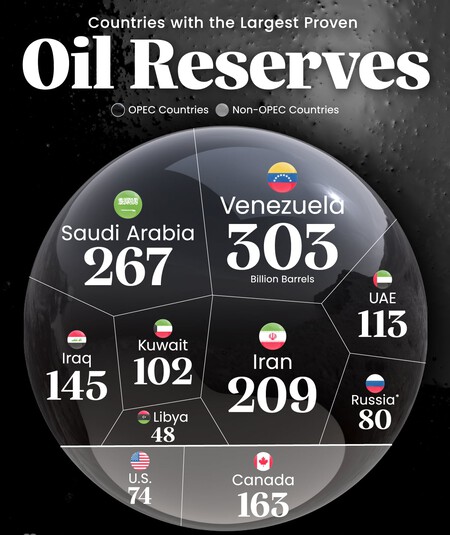
According to Visual Capitalist utilising data from the EIA , Venezuela boasts an astonishing 303 billion barrels of certified oil reserves, placing it firmly at the top of the list. In a close second is Saudi Arabia with 267 billion barrels . Iran follows suit, amidst recent tensions related to confrontations with Israel—illustrating the complex interplay of geography, energy resources, and international relations.
Other notable oil-rich nations like Canada, Iraq, the UAE, Kuwait, Russia, the United States, and Libya also feature prominently. Notably, the United States and Canada stand apart as they are not part of OPEC , the oil cartel founded to regulate prices and supply.
A Deep Dive into OPEC+
Established in 1960 , OPEC was formed by five founding members: Venezuela, Iran, Kuwait, Saudi Arabia, and Iraq. The organization’s primary goal is to coordinate and unify oil policies to maintain stable prices and safeguard the interests of member nations. Over the years, other countries joined, leading to the creation of the expanded OPEC+ group, though internal cohesion remains a challenge.
Member countries collectively control about 80% of the world’s oil reserves. However, despite Venezuela’s impressive reserves, political instability and other restrictions have hindered its production capacity. At their peak, Venezuelan output was nearly three million barrels per day , but now it struggles, producing only 770,000 barrels per day , ranking it as the twenty-first largest producer.
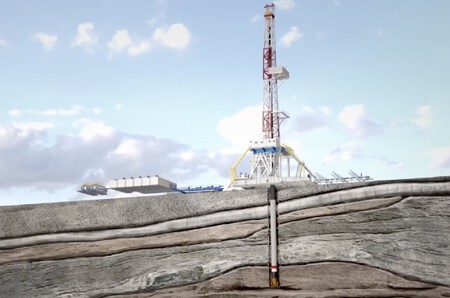
One of the wells operated by China
China’s Growing Role in Global Oil
As the world’s largest importer of oil, China has been quietly ramping up its internal production capabilities. Recently, the country achieved a historic milestone, producing 4.6 million barrels per day , the highest in its history. Despite this increase, China’s production levels still lag behind its immense import needs.
In a bid to fortify its energy security, China has reportedly amassed over 1.18 billion barrels of oil reserves, which could insulate it against supply disruptions. For context, the United States maintains reserves of about 400 million barrels , highlighting the strategic importance of oil reserves in times of crisis.

The Strategic Importance of Oil
Beyond its economic implications, oil reserves hold significant strategic importance for countries. The ability to influence global markets by coordinating production levels can serve as a powerful tool in international politics. Oil has often been a central factor in various military conflicts; for example, the Iraq War and ongoing tensions between Iran and Israel highlight how energy resources remain pivotal in geopolitical maneuvering.
In an increasingly energy-conscious world, understanding the dynamics of oil reserves and geopolitical relationships offers key insights into future trends. While renewables are on the rise, the existing reliance on fossil fuels suggests that oil will continue to play a critical role in the global economy for the foreseeable future.
Images: Visual Capitalist, CNPC
In conclusion, while the world grapples with the urgent need for cleaner energy sources, the reality of our dependence on oil remains a potent reminder of the complex interplay between energy, economics, and international politics.