
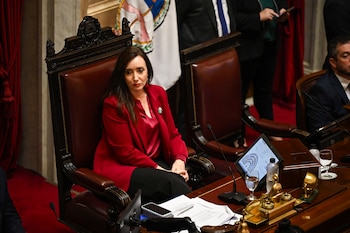
The ongoing saga regarding senators’ diets and the possibility of dissociating themselves from the latest increase recently initiated via decree by Vice President Victoria Villarruel has further strained relationships within the Senate. Villarruel, who once assured that she would step back from this issue, has become more aggressive in her communications with different legislative blocs. The irony lies in the fact that those who choose to receive the increase – which is less than $500,000 gross – will be allowed to donate it, while others will have to make a decision based on their current salary of just over $9 million , which, net, falls between $6.8 million and $7.2 million .
How did a week that began calmly turn into tensions by Friday? On Monday, it was revealed that a resolution, signed the previous Wednesday by Villarruel , acknowledged the impact of the recent collective bargaining agreement for Congress employees, proposing a 1.3% retroactive increase for March, April, and May. Villarruel then invited all senators to decide whether to adjust their respective diets accordingly and to formally inform the Presidency of their choice. Since April of last year, legislators have had their remunerations directly correlate with workers’ salary increases, effectively creating a rare moment of unity amid political divides.
The deadline for submitting their decisions was set for the end of the week. Consequently, a race ensued among senators to announce their personal choices, keenly aware of how this would play with both the government and the electorate. The potential difference equates to an increase from the current $9.1 million to $9.5 million gross starting next month. As of Friday at 7 PM, reports indicated that at least 30 legislators had submitted requests to detach themselves from the increase. It became evident that the Frente de Todos bloc, as previously noted, had no intentions of altering its stance on the matter.
Everything shifted dramatically by 8 PM, when the full list was released: 35 senators from the dialogue-oriented opposition – comprising members from parties such as the UCR , PRO , and a few provincial representatives – stood with the entire ruling party and Fernando Rejal from the Kirchnerist interblock. This effectively meant that nearly all Peronists and some from the dialogueist factions would continue to accept the hikes in their salaries. Amid this discussion, several senators argued for using these funds to support the Garrahan Hospital , as proposed by Lucila Crexell , while Rejal considered donating to a hospital in his home province. On the other hand, the UCR’s Flavio Fama suggested directing the funds to a local university.
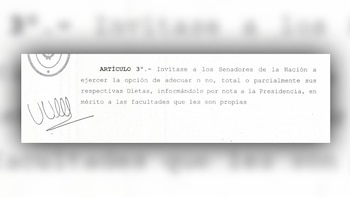
The central issue here is that, unlike financial commitments made before, senators cannot dictate to authorities how to allocate a portion of their salaries. Many choose to donate part of their wages, but this has led to instances where some senators exploit this to create fictitious charitable efforts without accountability, prompting a debate that seems to spiral into the realm of fantasy. Furthermore, those who submitted requests to dissociate themselves from the controversial increase will not benefit from the differential pay.
A message sent by Villarruel to party leaders has sparked significant backlash among various factions. “Weren’t you supposed to stay out of this? Now you’re publicly calling us out and rushing us? It feels like a pointless witch hunt. Why not discuss the numerous appointments you’ve made in recent weeks instead? Or address the missing resolutions ?” exclaimed a source from a frustrated office.
Others added their voices, denouncing the situation as an “institutional embarrassment.” “We’ve recently lost our administrative secretary, who was close to her. It’s not hard to see why the tension exists. Victoria has often not followed through on her commitments , and we’ll bear the consequences of that. I can only imagine the turmoil she’ll face when managing the ‘Casa’ with the impending renewal in December,” commented one insider, hinting at ongoing power struggles.
The most disheartening aspect for many remains the stagnation within the Senate. Legislative priorities suffer, with limited government agenda items to address and scarce opposition-led projects moving forward. “What happened to our agenda?” lamented someone from a dialogueist faction, projecting an air of defeat as the coming week, devoid of significant sessions, promises little hope for productive engagement. The small number of level-headed individuals maintaining connections between the vice president and differing factions stands out amid the prevailing chaos, alongside ongoing legislative efforts. Notably, the City of Buenos Aires will celebrate some form of success as it navigates these tumultuous waters.