
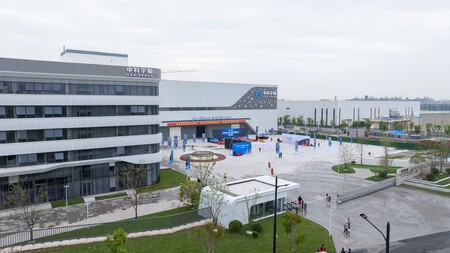
China’s Space Industry Takes a Giant Leap Forward
For over two decades, China has made significant strides in space exploration. Milestones include sending the first astronaut, Yang Liwei, into space aboard Shenzhou-5 in 2003, followed by groundbreaking achievements such as exploring the far side of the Moon and successfully completing its space station within a rapid timeframe. Now, China is entering a new phase — one that emphasizes the need for speed in manufacturing as well as exploration. This transition has been epitomized by the establishment of a “super factory” designed for mass-producing rockets.
The Birth of the Super Factory
Enter CAS Space, a Chinese private aerospace company that has inaugurated a facility in Shaoxing, Zhejiang Province. This super factory is aimed at facilitating the production of its Kinetica-2 liquid propellant rocket, with a target capacity of up to 12 rockets per year upon full operation. This initiative marks a significant move toward optimizing production techniques to support China’s ambitious space endeavors.
Integrated Production for Enhanced Efficiency
Unlike conventional assembly warehouses, this super factory will not just focus on the end stages of manufacturing. It will integrate both the manufacturing and testing of critical rocket components, which include propellant tanks, valves, and interstage sections. By concentrating production within a single facility, CAS Space hopes to reduce reliance on dispersed manufacturing processes and streamline quality verification.
Transforming Rocket Assembly Processes
CAS Space aims to revolutionize how rockets are handled within the facility. According to Li Qinfeng, the deputy design director of Kinetica-2, the factory will implement a pulse-based assembly and testing line. This innovative design will allow for the parallel assembly of multiple rockets and relies on standardized modular architectures and common components to maximize efficiency.
Long-Term Goals and Capacity Planning
While the factory is officially operational, it is crucial to note that CAS Space will initially spend the first two years focusing on refining its processes to enhance both quality and efficiency. The objective is to achieve full annual production capacity of 12 rockets within three to five years.
Kinetica-2: A Step Towards Future Launches
The Kinetica-2 is not merely an experimental design; its maiden flight occurred on March 30, 2026, successfully launching a series of satellites, including New March 01, New March 02, and TS 01. CAS Space intends to conduct approximately ten flights before the end of 2028 to test near-term reuse technologies and develop a reliable operational framework.
A Look at China’s Launch Forecast
According to the Securities Times, referenced by Global Times, China’s space launch initiatives are projected to surpass 100 this year, with over 60 missions dedicated to commercial activities. Among these, private operators will be responsible for more than 30 launches. This statistic highlights the urgency for a more systematic production strategy as it shifts the focus from simply possessing advanced launch capabilities to establishing a reliable manufacturing network.
The Road Ahead
Ultimately, the establishment of the super factory represents more than just a facility; it embodies a shift towards consistent and reliable rocket production. CAS Space has several adjustments ahead before achieving its production capabilities, and the Kinetica-2 still has performance benchmarks to meet. Nevertheless, China’s ambition to exceed 100 launches per year and deepen the role of private operators in its space ventures is now firmly on the horizon.
Images | CAS Space