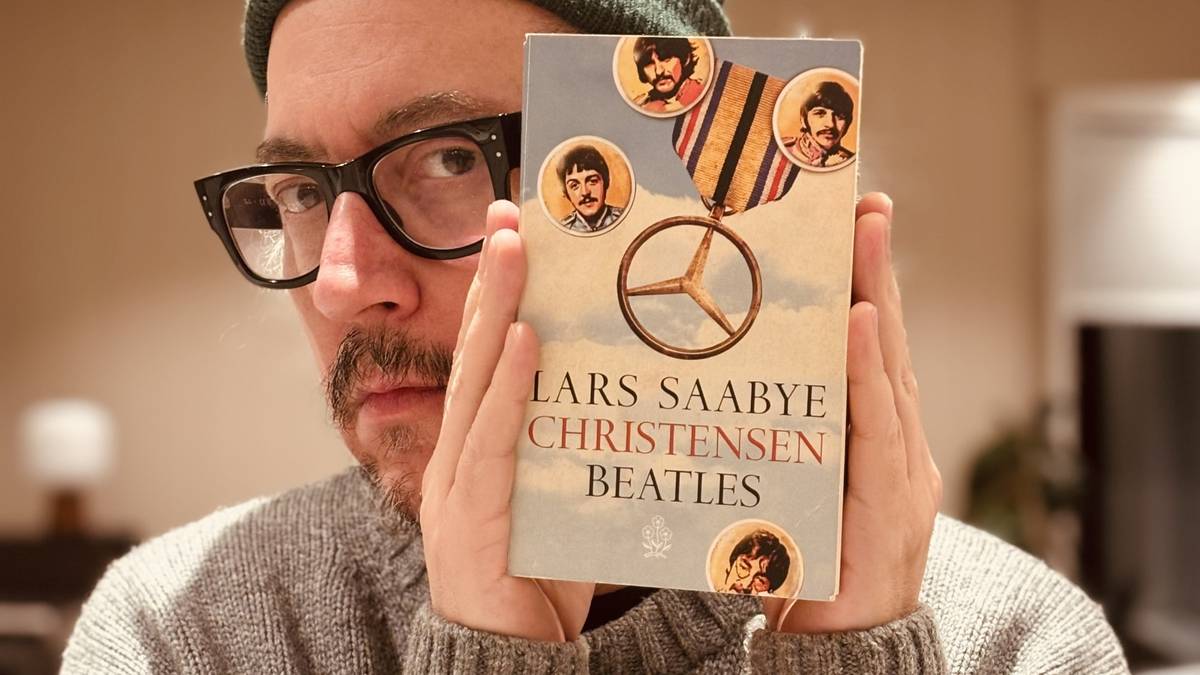
Hello in the Advent season! Finally, it is allowed to go bananas with lights and decorations to brighten up homes and neighbourhoods. I bought candles for over NOK 500 at Nille and carton wine at Polet for the same amount, so now there will be Christmas snuggles and Christmas stress in equal measure. I have finally read Ingvild H. Rishøi’s acclaimed Christmas novel “Stargate”, I am sharing a moving Palestinian poem, and we will celebrate the book that seduced a whole generation of Norwegian men. Put on tea, mulled wine or coffee, whatever you prefer. Norwegian literature’s answer to the Oscars, the Brage prize, has not always been so glamorous. This year, the invitation specified glitter and pomp, and at the end of November we trooped up the red carpet with all the bling we had. Kathrine Nedrejord posed in a festive cardigan with a giant loop and Brynjulf Jung Tjønn had got a pop star hairstyle that was worth seeing in itself. (swipe left) I got to hold Kathrine Nedrejord’s Brage statuette, and it is as heavy as a well-born baby! – My wife says I look like a K-pop star now, replied Brynjulf Jung Tjønn when I complimented him on the new weld. Kathrine Nedrejord did not hide her delight at the Brage prize for the novel “Sameproblemet” Both Yama and Ayesha Wolasmal are book topics this year, and big brother was very proud when little sister won the Brage prize for non-fiction. Many guessed what was in the cards when we saw Lars Saabye Christensen sitting on a table at the very front of the stage, even though he was not nominated. And quite rightly, the highest award, the Honorary Award, went to the 71-year-old author. I was not alone in thinking: – Huh?! Didn’t Saabye get the honorary award a long time ago? Lars Saabye Christensen is one of our most prolific and beloved authors. ACCEPTANCE SPEECH: Saabye is remembered when he sold self-written poems at Karl Johan, as an unknown young author. Photo: Siss Vik / news He made his debut with the collection of poems in 1976, but it was not until his ninth book that he really broke through – the generational novel “Beatles”. There we follow the four boys Kim, Ola, Seb and Gunnar from 1965, when they are in their early teens until they finish high school. A shared love of the band The Beatles binds them together, to the extent that they call each other Paul, Ringo, George and John. In 2006, Dagbladet’s readers voted “Beatles” as number one of the 25 best Norwegian novels and short story collections from the last 25 years. The sequels “Bly” (1990) and “Bisettingen” (2008) let us know how things went with the four friends from Skillebekk Three of the different covers the book has had in its many editions since 1984 Photo: CappelenDamm Nowadays we worry that boys read little, but in the eighties and nineties there was one novel that “all” boys read, and that was “The Beatles”. I remember well when I read the book and really enjoyed it. But it didn’t mean as much to me as it did to my brother and his buddies. Being part of a boy gang is obviously something that Lars Saabye captures in a humorous, melancholic and recognizable way. If there had been a National special task register, I am convinced that “Beatles” would be the book most boys have written a special project about. Author Zeshan Shakar is one of these. Photo: Jon Petrusson / news – I have a completely clichéd relationship with that book, says Zeshan in a gentle voice on the phone. The special assignment has long since disappeared, but he remembers how the book gripped him and some friends, who were otherwise not avid readers. – We stood outside in the store and talked about how far we had come. Shakar was 16 when he read “The Beatles”, and even though he and his friends lived 30 years later than the guys in the novel, and even though they listened to hip-hop and not the Beatles, they were taken aback. Zeshan blames the book for the fact that two friends dropped out of school and went on day trips, imprisoned by the lifestyle in the book. Shakar received the Tarjei Vesaas debutante prize in 2017 for his first novel, “Tante Ulrikke’s way”. It depicts two young men from Groruddalen, i.e. from east Oslo. But he and his friends didn’t think it made any difference that the book took place on the wrong side of town: – No, we thought of it more as an opportunity: Maybe you could write a Beatles book about us? When I started “Tante Ulrikke’s Way”, it was actually first about a gang of boys. The Beatles were definitely an inspiration for my writing. Read the Beatles with a dictionary Pedro Carmona-Alvares is a poet, novelist and musician. “The Beatles” was the first novel he read, and already in primary school. Photo: Siss Vik / news The special thing is that Pedro barely knew Norwegian at that time. The family had fled Chile and ended up in Kolbotn outside Oslo. Little Pedro became best friends with the Norwegian Fredrik, and they loved the Beatles. So when Fredrik’s dad came home with a thick new novel called “Beatles”, Pedro found the dictionary: – It took me half a year to read it, but “Beatles” was my way into Norwegian language, culture and post-war history and – to literature in general. When Pedro secretly wrote poems in secondary school, they were full of Saaby props such as cats and black umbrellas. But when he started at the Skrivekunstakademiet in Bergen, there was not much talk about Saabye Christensen. Those books were not in those circles in the nineties. But Pedro believes the book stands up well today: – “Beatles” is an ideal novel, with a straight narrative, well told, well seen and linguistically interesting. The novel is an incredibly wonderful study of the transition from youth to adulthood, poetic and with a nice nostalgia. There are few photos of Lars Saabye Christensen in his young years, but here he is in 1995 with “The Beatles”, from Svalbardposten. Photo: Tore Ole Ree When Zeshan Shakar re-read “The Beatles” as an adult, he saw how the author brought major political events down to living room level, and captured the spirit of the times without seeming contrived. But the kick the book gave him as a teenager was primarily as an adventure about four friends who were involved in borderline things. – The book takes place in the past, but paradoxically it told us about our future. It was like a divining ball for what we would experience in our teenage years. Pedro, who was after all a child when he read the book, also learned about youth things like falling in love and getting drunk: – The first time I threw up from vodka and orange juice, I thought of that scene in “The Beatles” where the guys are on a camping trip. Those of you who have read the book may remember that Gunnar gets drunk on the trip, so the other three put him outside the tent to prevent him from puking in the tent. But when Gunnar wakes up, really nauseous, he thinks he’s inside the tent. He therefore pulls down the zip and vomits – onto his sleeping friends. Pedro believes the book was particularly important for men, a mirror of the male collective: – It was an anticipated echo of experiences that would come later in life, and expanded the space we lived in. Have you read “The Beatles”? Of course! I love that book. I’ve read it, but it’s not that important to me. No, haven’t read it Show result Figures from the Deichman library in Oslo show that the lending of “Beatles” has dropped dramatically in the last ten years. In the 2020s, it has become rare for a Norwegian teacher to receive a special assignment about the generational novel “Beatles” now. Maybe time has run out from a book that takes place in a pre-technological era. More recent novels such as “Tante Ulrikke’s Way” and Oliver Lovrenski’s “Da vi var ynger” have taken over the favorite stamp of today’s young people. The question is whether the two books would have been created if the authors had not grown up with Saabye’s novel. What does the Brage prize recipient himself think that we complain about an old novel from 1984, he who has written so many popular books afterwards? Cille Biermann asked him about “The Beatles” when she interviewed him on the occasion of his 70th birthday last year. Saabye says that that novel is special, because with it he found his voice, and don’t be afraid, he just thinks it’s nice that people come up to him to this day to talk about it, Saabye Christensen also tells about when the script until the “Beatles” disappeared on a plane and were gone for several days. Had it not reappeared, Norwegian literature would have been poorer. Poem of the week Photo: Siss Vik / news At the end of February I started getting some strange letters in the mail. An A4 sheet, folded as if it were the start of a paper airplane or a small accordion, with my name and address in tiny print. When I unfolded the sheet, I found a poem, also in small print. What was this? I didn’t understand who it was from and what to do with it. The little pamphlets kept coming. When I cleaned my desk this week, the letters appeared among receipts, books and notes. I opened letter number one, which had a comforting title: “I give you shelter.” The poem was written by Hiba Abu Nada (b. 1991), a Palestinian biochemist, poet and award-winning novelist. It is dated 10 October, i.e. three days after Hamas attacked Israel and Israel responded with war. An I-voice promises to protect and provide shelter to children and parents who are hit by bombs: I give you shelter I give you shelter in invocation and prayer. I bless the neighborhood and the minaret to protect them from the rocket from the moment the order is given by a general until there is a raid. I shelter you and the little ones, the little ones who with their smiles change the course of the rocket before it lands. Hiba Abu Nada was only 32 years old when she was killed in her home in an Israeli bomb attack. 14 such poetry pamphlets, or banners, have been sent out to the media, parliamentary representatives, party leaders, libraries, the Red Cross, the Oil Fund, NATO’s secretary general, etc. What happened to them? Have they gone straight to the trash, or has someone read them and been moved? The poem is too long to be reproduced here in its entirety, but I asked my colleague Vera Kvaal to read the entire poem: Listen to the poem here, read by Vera Kvaal The unremarkable letter is a silent voice in the dramatic image of suffering we see in the media. But now I have shared Hiba Abu Nada’s poem with you, so her words live on with us. One of the initiators and translators, Monica Aasprong, recently visited Studio 2 and told more about the letters. She also read another lovely poem from the series of letters that are meant to be heard. A new Christmas tradition It’s nice to go to work during the day, because a big Santa greets me at the Christmas tree sale at Marienlyst. The scent of pine and fir lingers in the nostrils all the way into the news house. Photo: Siss Vik / news After reading “Stargate, a Christmas story” by Ingvild Rishøi, I think a lot about those who work to sell these Christmas trees. It’s a cold profession and you get children’s needles in your hair and mittens and clothes. Not least, I have learned that those of us who are going to have a Christmas tree should also buy decorative greenery, because that gives a commission to the sellers. “Stargate” received great reviews when it came out in 2019, but I only got to read it now, when Ukeslutt asked me to comment that pop star Dua Lipa has shared the novel with her 87 million followers, and TV star Oprah Winfrey has chosen the book for her Christmas book club . At first I laughed, then the tears flowed in the open office landscape. The novel about two girls who have to step in as Christmas tree sellers when their father neglects the job to get drunk is heartbreaking. The author and me in the radio studio with “Stargate” in Norwegian, British and American. Sad Christmas stories are some of the best I know. After a good Christmas laugh, you feel settled and calm. I think maybe Christmas stress and Christmas worries disappear with the Christmas years. I hereby start a new Christmas tradition: Reading “Stargate” every Advent. The short chapters make it suitable for reading as a Christmas calendar. Or listen to the whole thing on audiobook, it takes less than three hours. The coziest alternative is to read the story aloud to each other and laugh and cry a little together. Comment What kind of relationship do you have with “The Beatles”? Is it worth reading for today’s young people? Is it an Oslo phenomenon, or did it hit readers all over the country? Hello! Welcome to dialogue at news. Since you are logged in to other news services, you do not have to log in again here, but we need your consent to our terms of use for online dialogue Published 07.12.2024, at 11.04
ttn-69