
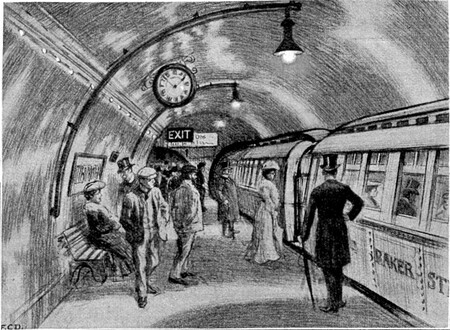
The London Underground stands as one of the most recognized public transport systems globally. Spanning over 408 kilometers with 274 stations and more than 543 units, this iconic network efficiently serves around five million passengers daily. The journey to this remarkable achievement, however, was neither instantaneous nor straightforward. The origins of the London Underground reveal a captivating narrative that commenced over 160 years ago with a revolutionary idea: the construction of an underground railway system. Let’s delve deeper into this fascinating history.
The Birth of a Network
In the 1830s, London held the title of the world’s largest city, acting as a bustling economic hub that desperately needed to relieve street congestion. The visionary concept emerged that trains could operate beneath the surface; however, such a venture had never been executed before. Following years of planning, a test tunnel was successfully completed in Kibblesworth in 1855, laying the groundwork for the world’s first underground railway. This new circuit linking Paddington (then Bishop’s Road) to Farringdon opened its doors on January 10, 1863.
Steam Engines and Gas Lighting
Initially, the locomotives used steam engines, and the carriages illuminated by gas lighting posed significant challenges. Commuters often found themselves traveling in cramped and polluted environments, enduring uncomfortable heat. Nevertheless, London’s growth continued and necessitated further transport initiatives, leading to the launch of the Metropolitan District Railway in 1868, which operated between South Kensington and Westminster, now integrated into the District and Circle lines.
Electric Revolution
Advancements in tunneling techniques propelled the expansion of the underground network. The City and South London Railway debuted the first electric railway on December 18, 1890, marking a crucial development that addressed many prior service drawbacks. By 1905, the electrification extended to the District and Circle lines, although the underground operated as independent systems until unification efforts in 1906, all while the name ‘Underground’ had yet to be officially adopted.
The Emergence of ‘Underground’
Various names including ‘Tube’ and ‘Electric’ were proposed, but ‘Underground’ prevailed, appearing first in 1908 along with the iconic roundel symbol. As technology progressed, 1911 saw the introduction of escalators and pneumatic door systems, enhancing user experience significantly.
Streamlining Transport Services
The merger of underground services with bus operations under the London Transport brand in 1933 represented a monumental shift. This unification allowed for a well-coordinated public transport system, culminating in Harry Beck’s innovative map design in 1933 that aided navigation across the vast network. Despite its initial skepticism, this map became a classic feature of London’s transport system.
Challenges and Transformation
World War II profoundly impacted the London Underground, converting it into a massive air raid shelter from September 1940 until May 1945. Post-war, in 1948, the London Passenger Transport Board underwent nationalization, eventually evolving into the London Transport Executive.
Tragedies and Innovations
The system has, regrettably, also seen tragedies. Notable incidents include the 1975 crash that killed 43 individuals and the devastating King’s Cross fire in 1987. Innovations such as the introduction of contactless payment systems and evening weekend services have been implemented since the early 2000s, with Transport for London (TfL) now overseeing the operation and management of this extensive network.
With continuous advancements and a commitment to improving service quality, the London Underground is not just a transport network; it is a symbol of resilience, innovation, and urban evolution.