
In March, a significant geopolitical development emerged when Russia declared its intentions to assert its presence in the Arctic by deploying a floating nuclear power plant . This announcement not only underscored Russia’s commitment to expanding its reach in a region rich in resources but also placed pressures on nations like the United States , which were slow to respond to this evolving scenario. Behind this maneuver was a stern numerical backdrop: the Russian fleet boasted eight nuclear icebreakers , setting the stage for increasing competition in the Arctic.
Almost simultaneously, China made headlines with its unprecedented deployment . The United States North Command (Northcom) and NORAD began monitoring the presence of five Chinese icebreakers operating in Arctic international waters off the coast of Alaska . This number represented an increase that was 2.5 times the current capacity of the U.S. Coast Guard in the region, marking a significant shift in the balance of power.
Among these vessels were research ships such as the Xue Long 2 , Ji Di , and Zhong Shan da Xue Ji Di . These ships have been closely observed by U.S. media as part of the Frontier Sentinel operation , initiated to counter what are perceived as hostile activities, protect national interests, and foster compliance with international maritime law. China’s deployment is indicative of a worrying three-year trend showcasing increasing Chinese engagement in the Arctic , further facilitated by climate change that has made previously inaccessible routes operable, notably the Northern Sea Route . This route plays a crucial role in China’s strategy to establish what it calls the Polar Silk Route , shortening maritime voyages to Europe by approximately 4,600 km .
Despite not being an Arctic state, China is rapidly enhancing its capabilities in the region, operating at least five icebreakers while planning the construction of dozens more . In contrast, Russia has a formidable fleet of icebreakers at its disposal, while the U.S. operates the USCGC Polar Star and the USCGC Healy , alongside other vessels like the CGC Storis , which has been slated for missions in the Arctic.
However, a stark reality is emerging. The majority of the U.S.’s twenty icebreakers are not suited for Arctic conditions, restricting their operational capabilities. The U.S. Coast Guard has issued a warning urging the necessity for modernization and expansion to safeguard national security and maritime trade. Although plans exist for 40 new icebreakers , the timeline has been hampered by delays, with the first Polar Security Cutter not expected to launch until at least 2029 , marking a significant gap in capacity compared to Russia and China .
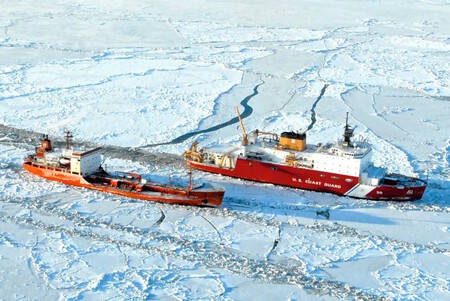
The USCGC Healy in action in the Arctic region.
In response to these challenges, the Trump administration allocated approximately $4.3 billion for three new heavy icebreakers and $3.5 billion for medium-sized vessels, reinforcing the commitment to enhancing the U.S. maritime presence. Furthermore, the ICE Trilateral Pact with Canada and Finland aims to meet projected demand for 90 icebreakers over the next decade. This agreement facilitates information sharing, personnel collaboration, and the joint acquisition of vessels built by allied nations, demonstrating an ongoing commitment to strengthen Arctic capabilities.
The strategic competition in the Arctic escalates with both Russia and China intensifying their military presence, reflecting their interest in the region’s abundant natural resources. Russia has significantly bolstered its military infrastructure , establishing air bases such as Nagurskoye and Trefoil Arctic Complex . In contrast, the U.S. has conducted multinational exercises, such as Arctic Edge 25 , partnering with allies like the United Kingdom and Denmark . However, operational limitations due to insufficient icebreakers present challenges in maintaining a robust presence in the region.
The simultaneous operations of five Chinese ships underline the urgency for the United States to address the icebreaker gap to maintain its influence in the Arctic. As these geopolitical dynamics unfold, the immense strategic importance of the region becomes increasingly clear.
The environmental thawing of the Arctic not only presents shorter routes between Asia and Europe but also exposes vast reserves of hydrocarbons, critical minerals, and new fishing grounds. For China, improving its footprint in this historically NATO-dominated region enhances its capacity for geopolitical influence and asserts its naval projection on a global scale.
As the Arctic landscape changes, it becomes apparent that for the United States , both Chinese advances and Russian supremacy in icebreaking capabilities highlight a pressing need for investments to ensure the defense of maritime routes, resources, and the preservation of influence as geopolitical competition intensifies.
Image | Us Coast Guard, USCG