
## Unveiling the Roman Luxuries: The Eagles Shipwreck in Switzerland
### The Background of Roman Culinary Traditions
Few products epitomize Mediterranean gastronomy as profoundly as wine and olive oil. Even today, these staples remain at the forefront of exports from Spain, a trend rooted deep in history. During the height of the Roman Empire, the Iberian Peninsula emerged as a vital part of its culinary landscape. A striking testament to this is Monte Testaccio, an artificial hill in Rome, primarily composed of ceramic amphorae, 80% of which originated from Baetica (modern-day Andalusia) and carried olive oil.
### Discovery of the Eagles Shipwreck
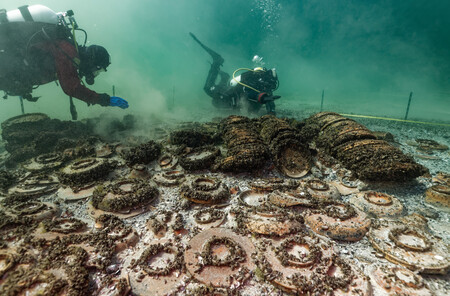
Recent archaeological findings in Lake Neuchâtel, Switzerland, have unearthed what is now known as the “wreck of the Eagles,” a ship presumed to have sunk between 17 and 50 AD. The ongoing excavation efforts by the Octopus Foundation have revealed an impressive cargo of approximately 600 artifacts. These include intact plates, bowls, and glasses, along with large fragments of amphorae, kitchen utensils encased in a preserved wicker basket, and various military items, including legionary weapons.
### Why This Discovery Matters
The discovery of the Eagles shipwreck underscores a significant aspect of the Roman Empire—its early globalized trade networks. This impressive logistical feat enabled the distribution of goods across three continents, from Great Britain to Asia Minor. Contrary to what one might expect, the Roman soldiers stationed in Switzerland had access not only to local products but also to flavors and luxuries from their homeland.
### Exceptional Preservation
The conditions at the lake’s bottom have contributed remarkably to the preservation of the artifacts. Cold temperatures and a lack of oxygen have kept the archaeological context intact, allowing researchers to piece together the ship’s organizational structure and the nature of its cargo, which blends civilian tableware with military supplies.
### The Importance of Supply Logistics
Analyses suggest that the cargo was essential for supplying a Roman legion, comprising around 6,000 men. The items likely journeyed from the Roman port of Yverdon to the north of Lake Neuchâtel. Interestingly, clues like swords found among the cargo indicate that this was likely a merchant ship under armed escort rather than a military vessel. However, no structural remnants of the ship have been found, leading researchers to consider the possibility that the ship didn’t actually sink at all.
### The Role of Olive Oil and Wine in Roman Life
The amphorae recovered are suspected to have held either olive oil or wine, both critical to Roman daily life. Olive oil was frequently termed “liquid gold,” utilized in cooking, lighting, personal hygiene, sports, and religious rituals. Wine, even when diluted with water, was integral to the diets of various social classes, including soldiers.
### Archaeological Techniques Used
The excavation process has been innovative, employing aerial drones for visibility and 3D photogrammetry to create detailed maps of the site. These maps were then divided into grids to facilitate meticulous object tracking and documentation, ensuring each item was recovered with care.
### Concerns and Future Directions
As sediment layers eroded due to historical hydraulic corrections, the artifacts became vulnerable to natural currents and potential looting. The urgency for excavation was instrumental in preserving these treasures. Currently, items from the wreck are under forensic analysis at the Laténium laboratory, aimed at identifying pottery workshops, content analyses of amphorae, and mapping trade routes. Ultimately, these findings will culminate in a public exhibition at the Neuchâtel Archaeology Museum.
### Conclusion
The Eagles shipwreck not only unveils a trove of Roman luxuries but also enriches our understanding of ancient trade networks, culinary practices, and advanced logistics that sustained the Roman legions. These archaeological efforts shed light on a fascinating intersection of history and gastronomy, reminding us of the rich legacy left by one of history’s great civilizations.