
Ruzafa: Valencia’s Trendy Yet Noisy Neighborhood
Valencia is known for its vibrant culture and culinary offerings, and one neighborhood that stands out is Ruzafa . This area is not just a visual feast; it’s a hub of gastronomic pleasures and leisure activities . However, the overwhelming noise during weekends has caused growing discontent among the local residents. In an attempt to address these concerns, the City Council of Valencia has proposed a creative solution aimed at minimizing noise levels: terraces that absorb sound and alert users when noise thresholds are exceeded.
The Innovative Project
This groundbreaking initiative is part of the Valencia Innovation Capital program, spearheaded by the Department of Innovation . The main goal is to establish a prototype that can potentially be replicated throughout the city. The project aims to uphold the right to rest for residents while adhering to principles of sustainability and climatic resilience . According to reports from Europa Press , the project is currently in its pilot phase, with Ruzafa selected as the testing ground. The pilot is slated to conclude in November .
Ecoterrazas: The Sound-Absorbing Terraces
The newly dubbed ecoterrazas have been installed in nine establishments along Cura Femenia Street , one of Ruzafa’s busiest pedestrian thoroughfares lined with numerous shops and restaurants. These innovative terraces come equipped with several advanced features designed to mitigate both noise and heat. The key elements of these terraces include:
- Umbrellas: Constructed with multiple layers and specialized fabrics that excel at reducing temperature.
- Phonoabsorbent Discs: Fabricated from materials that absorb sound waves, these discs also function as effective sunshades.
- Smart Lamps: These intelligent lamps are connected and will change to red when the noise level exceeds the allowed limit.
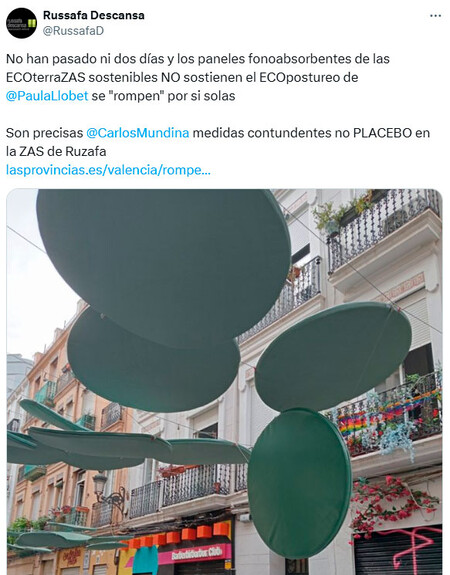
Click on the image to access the publication in X.
Community Concerns: Fed-Up Residents
Despite the innovative nature of the ecoterrazas , local residents have voiced their skepticism. The Ruzafa Residents Association has criticized the measure as merely “performative,” noting that within days of installation, several panels were already damaged. Moreover, while the project focuses on one heavily trafficked street, the noise problem encompasses more than twenty streets with nearly 300 bars and restaurants .
ZAS: The Acoustically Saturated Zone
Ruzafa has been classified as a ZAS (Acoustically Saturated Zone) , which imposes restrictions on opening hours and limits new terrace permits in the area. However, this declaration does not address other types of establishments contributing to noise pollution. Neighbors have flagged that the current measures do not include restrictions on bars and clubs, many of which are soundproof but still generate significant noise in the adjacent streets, especially during late-night hours.
Call for More Comprehensive Solutions
While the initiative to introduce noise-reducing terraces is commendable, it is essential to recognize that the noise problem in neighborhoods like Ruzafa extends beyond bar terraces. The day of the ecoterrazas’ installation, data revealed noise levels reaching 67 decibels in the vicinity. The City Council’s sonometric study notes a maximum noise spike of 74 decibels , highlighting ongoing issues that demand more nuanced solutions beyond physical infrastructure.
Images sourced from Valencia Innovation Capital and Wikipedia illustrate the challenges and innovations taking place in this bustling neighborhood. The Ruzafa situation encapsulates the struggle many vibrant urban areas face in balancing community well-being with economic interests. As such, it serves as an important case study for other cities grappling with similar urban dilemmas.