
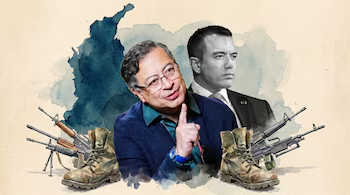
Military Siege in Valle del Cauca: A Response to Ecuador’s Concerns
The southwestern region of Colombia has recently entered a heightened state of military surveillance following the Colombian government’s decision to bolster security controls in major cities like Cali, Jamundí, and Palmira. This development is largely a reaction to concerns voiced by Ecuadorian President Daniel Noboa regarding cross-border incursions by armed groups from Colombia.
Activation of the Padlock Plan
In response to the perceived threat, President Gustavo Petro implemented the so-called “padlock plan.” This initiative aims to secure sensitive mobility corridors and restrict the inflow of weapons into Valle del Cauca. The urgency of this action stems from Noboa’s allegations that illegal armed groups have been irregularly crossing the border, constituting a considerable risk to Ecuador’s national security.
Political Tensions Between Colombia and Ecuador
President Petro’s military response comes amidst escalating political tensions. He explicitly connected this military mobilization to statements made by President Noboa, who accused Petro’s government of sending guerrillas to Ecuador. Petro retorted, emphasizing the interconnectedness of both nations: “I do not consider Ecuador anything other than part of the Great Homeland.”
Petro has also raised eyebrows regarding Noboa’s affiliations with former Colombian President Álvaro Uribe Vélez and the right-wing sectors in Colombia. He argued that this ‘Uribe/Noboa alliance’ aims to undermine the democratic process in Colombia by instilling fear among the populace as election season approaches.
The Broader Context: Drug Trafficking Concerns
Through his communications, Petro has linked the issue of border security to the larger problem of international drug trafficking. He stated that criminal organizations manage routes from Ecuador’s ports, essentially placing the blame for the drug trade on Noboa’s administration. Petro reiterated the need for reinforced military presence along the Colombian-Ecuadorian border, emphasizing that weapons and explosives are entering through these crossings, primarily aimed at drug trafficking operations in Colombia.
Implications for Electoral Security
As Colombia gears up for its presidential elections on May 31, 2024, the political strategy plays a crucial role. During his statements, Petro expressed his belief that the ‘extreme right’ is seeking to manipulate public sentiment through fear tactics. He reiterated, “Let Noboa/Uribe know that the people do not give up,” signaling a call to action for his supporters amidst a backdrop of rising tensions.
Military Deployment and Collaborative Efforts
In tandem with these political maneuvers, Colombia’s Ministry of Defense has confirmed ongoing military operations in Valle del Cauca and northern Cauca. The National Army, in collaboration with local police forces, has established checkpoints and surveillance systems designed to enhance safety in these troubled regions. An armored platoon has been allocated for greater security oversight, and the Colombian Aerospace Force is executing aerial surveillance to monitor key transit routes.
Conclusion
The recent activation of military measures and the political confrontation between the two nations spotlight the intricate relationship Colombia shares with Ecuador, particularly concerning security and drug trafficking issues. As both leaders navigate these challenges amidst looming elections, the impact of their strategies will be closely scrutinized by both domestic and international observers. The ongoing developments promise to shape the political landscape, further complicating relations and security in the region.