
Telespazio’s Historic Stratospheric Flight: A Leap into the Future
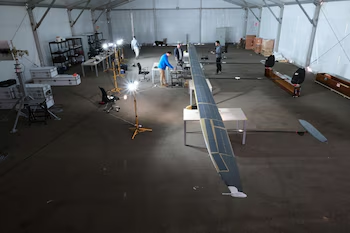
The recent inaugural flight of the HAP Apus Neo 18 marks a significant milestone in the realm of aerial surveillance and emergency management in Europe. This high-altitude pseudosatellite (HAPS) took off from the Fuerteventura Technology Park, representing the first certified experimental flight of its kind on the continent. With a wingspan of 18 meters and a weight of approximately 45 kilos, this aircraft is poised to enhance various applications, including fire monitoring and emergency response.
The Significance of the Flight
Telespazio, the Spanish subsidiary of Thales and Leonardo, has simply made history by obtaining the first European authorization from national aeronautical authorities such as Enaire and the State Aviation Safety Agency (Aesa). This approval allows for long-range stratospheric flights using HAPS systems, which are crucial for enhancing prevention and response capabilities, particularly in areas prone to forest fires like the Canary Islands.
Collaborative Efforts Under ISSEC
The project—dubbed ISSEC—represents a collaborative effort between Telespazio and Pegasus Aero Group. Development takes place entirely within the state-of-the-art facilities of the Fuerteventura Technology Park. This initiative also aims to create advanced capabilities to tackle sixth-generation forest fires, which pose significant challenges to existing surveillance and response mechanisms.
In addition, the project plans to incorporate a stratospheric balloon from the German group TAO shortly, complementing the HAP Apus Neo 18 in surveilling the island of Gran Canaria.
Objectives and Flight Protocols
The primary goals of the initial flights are twofold: to validate the safety and operability of the segmented stratospheric flight system and to evaluate the quality of the data transmission technologies developed by Telespazio Ibérica. These flights will progressively ascend from roughly 610 meters (2,000 feet) to nearly 4,900 meters (16,000 feet), with potential mission durations extending up to 48 hours.
Advantages of Pseudosatellites
Unlike conventional satellites, the flexibility of pseudosatellites allows them to relocate to specific areas as needed, maintaining position for weeks while delivering real-time images and videos. This capability greatly benefits early detection and monitoring of fire sources, as well as assessment of damage post-incident.
Telespazio emphasizes that HAPS technology offers continuous and specialized data on threatened regions, making it a valuable asset both for preventive planning and crisis management in emergencies. The high-resolution surveillance provided by HAPS serves to complement traditional satellite solutions, particularly in challenging terrains.
Industry Impact and Future Prospects
Carlos Fernández de la Peña, CEO of Telespazio Ibérica, remarked on the significance of this initial operational step, believing it propels the project into an “alternate dimension.” The successful experimentation with HAPS stratospheric flights opens up possibilities for pioneering technologies in the European aerospace sector, positioning the Canary Islands as a leader in advanced environmental surveillance and emergency management systems.
The operation is structured with progressive security protocols and segmented flights, ensuring a gradual certification of all procedures and equipment. As the project advances, it is expected to provide enhanced territory control and real-time analytics, allowing for more effective risk management and emergency coordination.
In conclusion, Telespazio’s efforts in high-altitude pseudosatellite technology not only signify a technological leap for Europe but also introduce promising new strategies for crisis management. The Fuerteventura Technology Park stands as a beacon of aerospace innovation, setting a benchmark for future endeavors in aerial surveillance and emergency response systems.