
Telefónica’s Remarkable Growth Amidst Market Challenges
Between July and September , Telefónica achieved an impressive 80,000 net additions through portability—combining both mobile and landline services . This marks the highest figure since the portability mechanism was implemented in 2000 , according to the latest data reported by Expansion.
Despite operating within a highly competitive landscape that has seen it lose customers almost uninterruptedly for 25 years , Telefónica’s latest performance signals a notable shift. Since May 2024 , the operator has seen 17 consecutive months of positive results in its mobile sector, a streak that is experienced only by Digi.
Why is it important? Portability serves as a critical measure of who best understands the user’s desires and effectively meets them. This is no mere statistical noise; it represents money , market share , and the capacity for customer retention .
Previously, Telefónica had been a natural loser in the portability game, stemming from its history as a monopolistic provider. Now, however, the narrative appears to be changing. Whether due to strategic shifts in its service offerings or changes in market dynamics—or a combination of both—Telefónica seems to be reversing its fortunes.
The figures:
- In mobile, Telefónica added 64,000 net lines this quarter, a significant increase from 45,000 during the same period in 2024 . Up to now this year, it has accumulated a total of 135,000 new lines , nearly ten times the 14,000 gained in the first nine months of the previous year.
- In fixed services, it achieved 16,000 quarterly registrations , marking its best historical record and maintaining a positive trend for the past six months.
This is the first time that Telefónica has managed to achieve two consecutive quarters of gains in both mobile and fixed markets simultaneously.
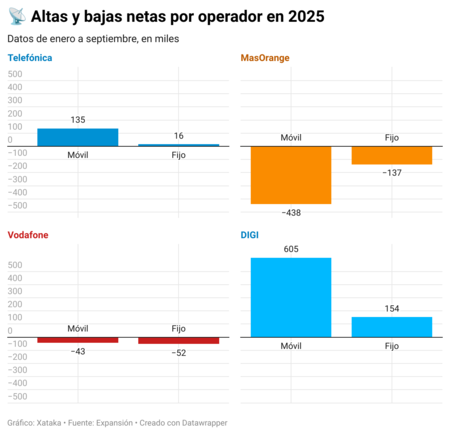
The contrast: While Telefónica and Digi experience growth, MasOrange and Vodafone are struggling:
- MasOrange lost 138,000 mobile lines in the quarter, contributing to a total of 438,000 losses so far this year, up 50% from 2024 . Vodafone, excluding Finetwork’s numbers, is closer to achieving positive results than MasOrange but still remains in the red.
- Digi, in comparison, gained 177,000 quarterly registrations , representing a 21% increase from the previous year and leading with 605,000 lines acquired between January and September .
Between the lines: The market is becoming increasingly polarized:
- Telefónica is attracting and retaining premium customers , who prioritize service , quality , and stability over price.
- Digi dominates the low-cost segment , where the focus is entirely on the cheapest rates available.
- Operators in the middle—such as MasOrange with its legacy budget brands and Vodafone dealing with lingering past issues—are losing customers from both ends.
Nevertheless: MasOrange faces a fundamental concern with many of its brands— MásMóvil , Yoigo , Pepephone , and Simyo —losing customers who are highly sensitive to pricing.
Vodafone’s challenges stem from its decision to exit the football broadcasting realm in 2018 , which triggered a significant loss of subscribers from which the company has yet to fully recover. It now faces uncertainties related to Finetwork and suffered a loss of 48,000 lines this quarter.
The backdrop: To find a quarter similar to Telefónica’s performance now, one must look back to 2018 , when Vodafone exited football, allowing Telefónica to gain 66,000 net lines . However, that period was transient—a mere reaction to competitors’ missteps. Now, Telefónica’s success appears to be a sustained improvement, clocking 17 months of growth without any catastrophic mistakes from its rivals.
Simultaneously, smaller virtual operators are beginning to fade from the market, having lost 11,000 net lines in the third quarter, contrasting with the 9,000 gained in the previous year. The competitive landscape is increasingly simplified, with larger operators like Telefónica, MasOrange, and Vodafone maintaining their infrastructures, while the low-cost disruptor Digi continues to thrive while the rest seem adrift.
In summary, Telefónica’s recent performance demonstrates its ability to adapt and thrive in an ever-evolving telecom landscape, even as competitors continue to struggle.