
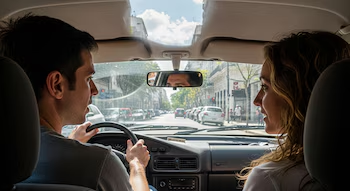
Impact of Talking While Driving on Reaction Times
Recent research published in PLOS ONE indicates that engaging in conversation while driving can lead to significant delays in both eye movements and critical reflexes necessary for safe driving. This study carefully examined how the act of talking influences drivers’ ability to react effectively in unexpected situations.
Cognitive Load of Conversation
Unlike passive activities such as listening to music or an audiobook, talking requires additional cognitive effort. This increased mental load results in slower reactions to visual stimuli. As the study points out, drivers who converse while driving display delayed responses in both detecting hazards and reacting appropriately to them.
Interestingly, even hands-free systems do not mitigate this detrimental effect. The researchers emphasized that these seemingly minor delays accumulate, thereby increasing the risk of accidents on the road.
Attention Distribution and Visual Control
Experts attribute the observed delays to how the brain processes and distributes attention during conversations. The mental effort required to articulate responses interferes with mechanisms that control eye movements, which are vital for responding to unforeseen events while driving.
Shintaro Uehara, an associate professor at Fujita Health University and lead author of the study, elaborated, “These results indicate that the cognitive demands associated with speaking interfere with the neural mechanisms responsible for initiating and controlling eye movements.” This is crucial for effective visuomotor processing during driving.
Experimental Insights
The study involved 30 adult volunteers who underwent visual tests in a controlled environment. Participants were asked to focus on targets that appeared randomly, with their response speed and accuracy measured under three conditions: talking, listening to audio clips, and complete silence.
The results revealed alarming findings. All participants exhibited substantial delays in their eye movements when engaged in conversation. Specifically, the average reaction time to visual stimuli during conversation was 279.7 milliseconds, compared to 260.4 milliseconds when listening and 261.3 milliseconds in silence. The variations in gaze movement and eye stabilization times were even more pronounced.
Understanding Inattentional Blindness
Another significant factor discussed in the study is “inattentional blindness.” This phenomenon may cause delayed reaction times even if a driver is looking directly at a potential hazard, such as the taillights of the vehicle ahead—emphasizing the dangerous combination of divided attention and visual processing issues.
Implications for Driver Safety
While the research was conducted in a simulated environment devoid of real vehicles, previous studies support the conclusion that using mobile phones while driving greatly heightens the risk of collisions. According to a study published in BMJ, handling a cellphone can quadruple the likelihood of an accident, even when using hands-free devices.
The primary goal of these studies is to foster a better understanding of driving safety. They aim to generate awareness about the potential risks associated with talking while driving and to promote safer driving practices.
Recommendations
The findings make it clear that any activity requiring verbal engagement should be avoided while driving. While listening to audiobooks causes no negative effects on visual reflexes, conversing does impede them. Evidence suggests that even brief cognitive distractions can yield severe consequences on road safety.
The scientific community continues to explore the complexities of these delays and their implications. However, the key takeaway for drivers is clear: limiting conversations while driving can significantly reduce the risk of accidents and save lives.