
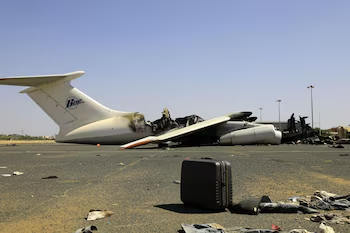
The Tragic Death Toll in North Darfur
The recent airstrikes in North Darfur have resulted in significant civilian casualties, with reports indicating that at least 64 individuals lost their lives. Among the deceased are family members of Mohamed Hamdan Dagalo, known as ‘Hemedti’, the commander of the Rapid Support Forces (RSF). A tribal leader, Bashir Barma Baraka Allah, was also among the fatalities during the strike on the Ghurair market. The RSF has placed the blame squarely on the Sudanese Army, raising alarm over the safety of civilians amid ongoing conflict.
Details of the Airstrikes
According to the RSF’s statement, the hostilities commenced with a drone attack in the Al Zarq and Ghurair regions, reportedly utilizing a Turkish Akanji model drone. The assault destroyed the Al Zarq hospital and resulted in substantial casualties. Subsequently, another unmanned aerial vehicle targeted the Ghurair market, leaving behind “dozens of dead” and incinerating the marketplace with those inside.
International Concerns and Humanitarian Responses
The United Nations Office for the Coordination of Humanitarian Affairs (OCHA) voiced profound concern over the devastating effects of the airstrikes. They underscored the necessity for accountability from conflicting parties, reminding them that civilian protection is an obligation under international humanitarian law. Notably, OCHA emphasized that medical facilities should never be targeted in conflicts.
Accusations against the Sudanese Army
The RSF, backed by various media outlets, accused the Sudanese Army of intentionally targeting civilians, asserting that the attacks aim to instill terror and deprive local communities of their livelihoods. The destruction of community spaces has exacerbated the already fragile conditions in several regions of western Sudan.
The Uncertain Path Forward
Despite the gravity of the situation, there has been no official comment from the Sudanese Army regarding the airstrikes and their outcomes. This silence only deepens the uncertainty surrounding the sequence of events and the motivations behind such attacks. North Darfur, already ravaged by internal conflict, faces ongoing allegations of abuses from both the Army and paramilitary groups.
Escalating Violence and Humanitarian Needs
Organizations on the ground have persistently highlighted the vulnerability of affected communities, urging for international intervention to prevent further loss of life and the systematic destruction of vital infrastructure. The shift towards the use of advanced foreign drones in these bombings indicates a concerning escalation in military tactics, making it increasingly challenging for medical and rescue teams to respond promptly.
Calls for Accountability
As the demand for independent investigations into these incidents grows, humanitarian organizations are insisting on accountability for the attacks. The recurrence of assaults on civilian sites—particularly hospitals and markets—raises serious questions about the compliance of involved parties with their commitments under international treaties protecting civilians during armed conflicts.
The Ongoing Crisis in Darfur
The enduring violence, combined with the destruction of critical infrastructure, continues to contribute to a humanitarian emergency in North Darfur. Residents and global observers are fervently seeking clarity on the situation and ensuring support for survivors amid deteriorating conditions. The plight of the civilian population remains dire, demanding immediate and effective responses from both local and international actors.