
The Gas Revolution: China’s Leap Towards Energy Independence
As Europe keeps a close watch on its gas deposits, currently standing at 76% full as winter approaches, a contrasting narrative unfolds in China. While the West prepares for a cold season, the Asian giant is rapidly extracting natural gas at an unprecedented pace. This strategic maneuver is more than just about stockpiling; it’s about redefining its energy security protocols.
The Awakening of a Gas Giant
China has long been recognized as a powerhouse in energy, not only as a leader in the renewable sector but also as a considerable oil importer. However, its latest phase of ambition is crystallizing a new identity: that of a gas axis . Over the last two decades, Beijing has executed a remarkable transformation. It has reduced its near-total reliance on gas imports and now boasts a sharply increasing domestic production rate. Analyst John Kemp indicates that domestic production has surged nearly 10% annually since the early 2000s, especially in Northwest provinces like Xinjiang, Shaanxi, and Inner Mongolia, which have seen increases of up to 13% .
<img alt="China has laid more than 10,000 km of underwater pipes: the plan is to convert the ocean into its energy muscle" width="375" height="142" src="https://i.blogs.es/ff21a9/tuberias-submarinas/375_142.jpeg"/>Three Main Levers of Change
China’s transformation into a gas giant relies on three main levers:
- Technical Advancements: The first and arguably riskiest strategy has been penetrating unexplored depths of up to 10,000 meters . Major state-owned companies like Sinopec, CNOOC, and Petrochina have shifted their focus toward developing challenging shale gas reserves, particularly in Sichuan. This effort is not merely technical; it serves a broader political aim of mitigating foreign gas reliance, despite the high costs of drilling in geologically hostile environments.
- Geographical Reorientation: Secondary regions on China’s energy map, notably Xinjiang and Inner Mongolia, are becoming pivotal to the gas sector. With unwavering support from Beijing, these territories now host numerous conventional and unconventional gas projects, all linked by a comprehensive logistics network that connects them to major consumption centers in the east.
- Geopolitical Moves: On the international front, China has signed a pivotal agreement with Russia for the construction of the Power of Siberia 2 gas pipeline. This infrastructure is forecasted to deliver up to 50 billion cubic meters of gas annually from Yamal to Northern China, safeguarding China’s long-term energy supply, potentially at reduced costs, while insulating it from global LNG market volatility.
The Numbers Do Not Lie
Official statistics from Xinhua demonstrate this profound energy shift. From January to June 2025, China produced 130.8 billion cubic meters of natural gas, marking a 5.8% increase over the previous year. June’s production alone hit 21.2 billion cubic meters , reflecting a 4.6% year-on-year growth. The International Energy Agency (IEA) has acknowledged the increasing importance of gas in China’s energy portfolio, lauding its flexibility and lower emissions compared to coal. However, they also emphasize that China must double its efforts to achieve sustainability goals.
Meanwhile, imports of liquefied natural gas ( LNG ) are on a steep decline. Data from Bloomberg indicates that Chinese LNG imports may drop by 22% year-on-year in September, amounting to 5.4 million tons . This marks the eleventh consecutive month of decreasing imports. Analysts predict a reduction of total imports for 2025 between 6% and 11% , driven by stronger local production and increased pipeline flows from Russia and Central Asia .
Infrastructure for Independence
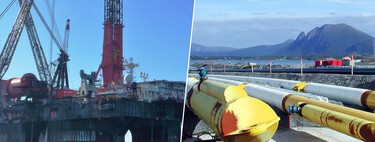
China’s approach is not limited to production; it has also developed an extensive and sophisticated underwater pipeline network. This network spans more than 10,000 kilometers , interlinking gas platforms, wind farms, and refineries to the mainland infrastructure. Projects like the Bay of Hohai and Deep field No. 1 symbolize this new frontier in energy independence. These pipelines transport gas now and may soon carry hydrogen in the future, representing a strategic maneuver to bolster national supply and mitigate vulnerability to international market fluctuations.
Future Forecasts
The IEA predicts that Chinese gas consumption will peak by 2035 , stabilizing thereafter due to advances in electrification and renewable sources. In the short term, demand is expected to remain moderate, aided by steady domestic production. The ongoing investments in deep drilling and the expansion of maritime infrastructure further solidify China as a self-sufficient energy player, thereby enhancing its bargaining power against traditional gas exporters like the U.S. , Qatar , and Australia .
The New Energy Landscape
While Europe conserves gas supplies to ensure it survives the winter, China is drilling deeper to become independent. In just twenty years, the Asian nation has flipped its situation from a reliance on fluctuating imports to negotiating from a position of strength. If everything goes according to plan—expanding domestic production, building pipelines through 2030 , and launching the Power of Siberia 2—Asia could fundamentally reshape the global gas landscape. Europe’s current feeling of relief regarding gas reserves might soon dissipate, as the next energy crisis could be determined not in Moscow or Doha, but deep within China’s bureaucratic halls.