
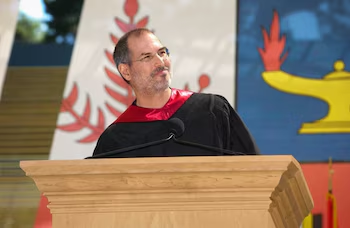
Steve Jobs, the visionary co-founder of Apple Inc., famously shared in a 2005 address at Stanford University that he left college after just six months, as he felt uncertain about how his education would provide meaning to his life. At the tender age of 17, Jobs began his journey at Reed College, a decision made with the backing of his adoptive parents. However, financial constraints soon loomed large, prompting him to prioritize his curiosity over conventional education.
Reflecting on His University Experience
During his Stanford speech, Jobs recounted the pivotal moment when he broke from traditional academic paths: “I dropped out of Reed College after the first six months, but continued to attend off and on for about 18 more months before quitting for good. After six months, “I didn’t see the point.” This sentiment echoes the struggles many face when questioning the value of their education.
Jobs articulated the frustration of investing his parents’ hard-earned savings into tuition without a clear vision of his future. He stated, “I had no idea what I wanted to do with my life or how college would help me figure it out.” His financial and emotional sacrifices were immense; he often found himself sleeping on dormitory floors, returning empty Coca-Cola bottles for spare change, and trekking seven miles each Sunday for a meal at the Hare Krishna temple.
Discovering Passion Beyond the Classroom
Importantly, dropping out enabled Jobs to pursue unconventional interests that ultimately shaped his innovative mindset. One notable experience was a calligraphy class that profoundly influenced the design ethos of Apple’s early products. As he noted, “If I hadn’t dropped out of college, I would never have attended that calligraphy class and personal computers perhaps would not have the wonderful typography that they have today.”
The Birth of Apple Inc.
At just 20 years old, Jobs, alongside co-founder Steve Wozniak, launched Apple in a family garage. The company swiftly grew into a tech behemoth, racking up $2 billion in revenue and employing over 4,000 individuals within a decade. However, it wasn’t a smooth ride; by the age of 30, Jobs encountered significant setbacks, including being ousted from the very company he built. He described this as a public failure, prompting thoughts of leaving Silicon Valley.
Lessons in Resilience
Despite these challenges, Jobs’ passion for his work never waned. He reaffirmed, “I still loved what I did,” leading to the establishment of NeXT and Pixar and the eventual resurgence of Apple through the integration of NeXT technology. His journey illuminated the connection between failure and innovation, reinforcing the importance of resilience.
Reflections on Life and Death
Job’s perspective deepened profoundly following his pancreatic cancer diagnosis, delivering a sobering reminder of mortality. His doctors advised he might only have three to six months to live, prompting him to reflect on life choices. “Remembering that you are going to die is the best way I know to avoid the trap of thinking you have something to lose,” Jobs shared, emphasizing the value of following one’s heart and intuition.
In his concluding remarks, Jobs urged young individuals to resist societal pressures and to seek their own paths: “Your time is limited, so don’t waste it living someone else’s life… most importantly, have the courage to follow your heart and your intuition.” This message resonates with anyone questioning their life direction, highlighting the transformative power of living authentically.