
The Quest for a Flag of Humanity
Borders and flags too often become symbols of conflict and division. However, when viewed from the vastness of space, such as in the recent images captured by Artemis II, we are reminded that we share a common bond on this blue planet. Yet, despite our shared existence, humanity has yet to adopt a flag that truly represents us all. Over the years, various proposals for a “Flag of Humanity” have emerged, with renewed interest as we set our sights on the Moon and beyond.
Historical Proposals for a Unified Flag
The Earth Flag by James Cadle (1970)
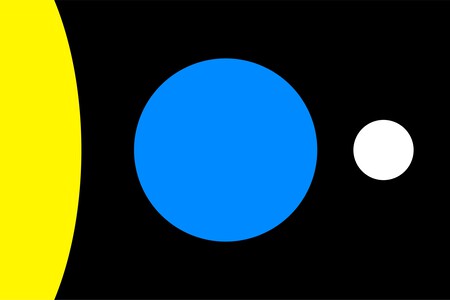
The journey towards a unified flag began in 1970 when Illinois farmer James Cadle was inspired by the Apollo 11 Moon landing. He designed the Earth Flag, which features the Earth depicted as a blue marble accompanied by a smaller white representation of the Moon against a yellow and black background, symbolizing the Sun and the void of space. Cadle initially raised this flag on a rural power pole, but it has since been embraced by several space missions.
Minimalist Designs: Anne Kirstine Rønhede (2000)
Fast forward to 2000, when Danish designer Anne Kirstine Rønhede created another compelling flag for Earth. This design features a light blue marble surrounded by a white border that signifies the atmosphere, set against a darker blue backdrop representing the cosmos.

A Symbol of Unity: Oskar Pernefeldt (2015)
In 2015, Swedish designer Oskar Pernefeldt introduced a flag comprised of seven interlinked circles, one for each continent. This design emphasizes global unity and aims to serve as a symbol for Earth during future Mars missions.

The Influence of Science on Flag Design
Messages from the Cosmos
The launch of Artemis II has invigorated the search for a flag that embodies our planetary identity. It was figures like Frank Drake and Carl Sagan who first combined scientific knowledge to communicate with potential intelligent life in the universe. They crafted the Pioneer Plaque, a gold-anodized aluminum plate intended for that purpose, along with the Arecibo Message, a patterned radio signal transmitted through the Arecibo Telescope.
The Pulsar Map Flag
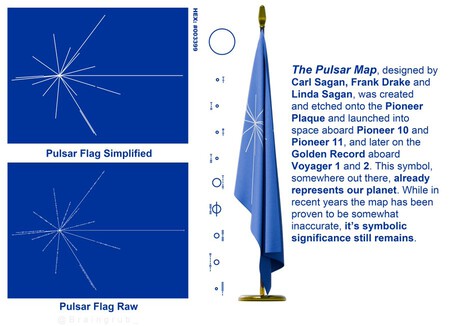
Recently, 2D and 3D designer braingrub has offered a new Earth flag proposal based on the Pioneer Plaque’s pulsar map. This diagram indicates Earth’s position in the Milky Way using 14 lines that point to various pulsars, which serve as beacons for navigation in space. Each line features binary codes representing the individual pulse of these stars, simplifying the task for any intelligent civilization seeking to locate Earth.
The Ideal Moment for a Flag of Humanity
In today’s world, marked by division, the notion of a flag to represent all of humanity is more pertinent than ever. The swirling ideas surrounding a Flag of Humanity, especially those grounded in scientific exploration and unity, strike a chord at this significant moment in history.
Conclusion
As we stand on the brink of interplanetary exploration, contemplating our shared existence becomes essential. Proposals for a unified flag not only provide a tangible symbol of our species but also remind us of our collective responsibility to foster peace and unity on Earth.