

The Current State of Spain’s Real Estate Market: A Shift in Trends
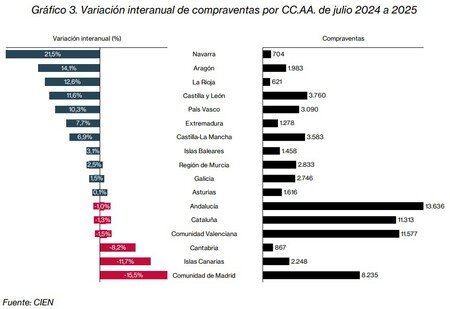
As the real estate landscape in Spain evolves, recent statistics reveal some surprising shifts. Following a sustained period of high demand in the real estate market—wherein the demand often outstripped supply—the second quarter of this year presented a surprising downturn. Regions such as Madrid , the Balearic Islands , the Canary Islands , and Cantabria saw a decline in home purchases compared to last year. Notably, despite this decrease in transactions, property prices have continued to soar, particularly in Madrid.
There are indicators suggesting that the rapid price increase may finally be reaching a plateau in some of the country’s most volatile markets. This is significant as it indicates a cooling off period for an overheated sector.
Understanding the Shift
The Madrid real estate market is currently undergoing a peculiar transformation. While the overall market in Spain is witnessing an uptick in sales, Madrid has experienced a contrasting downturn in transaction volume . Official reports indicate a drop from 23,267 transactions in 2024 to 21,614 in the second quarter of 2025—representing a decline of 7.1% . This statistic is particularly notable when juxtaposed against a national average increase of 3.1% during the same period.
Madrid is not alone in this trend; other regions, including the Balearics and Canary Islands , have also reported declines. But the capital stands out for its more pronounced fall in sales.
Impact of Sales Volume on Prices
Though the volume of sales has dropped in Madrid, the prices of the remaining properties that are sold have increased dramatically. The latest data from official sources indicates that the cost per square meter in the free market of the Community of Madrid surged from €3,198 in the second quarter of 2024 to €3,630 in the same period of 2025—an astonishing increase of 13.5% . In contrast, the national average only observed a 10.4% rise.
Insights from Notaries
According to reports from the General Council of Notaries , the trend echoes similar results. Their findings indicate that despite a decline in sales, prices in several regions, including the Canary Islands and Catalonia , continued to rise. In fact, Madrid is now the second-highest for property prices, trailing only behind the Balearic Islands , where the cost per square meter hits €4,100 .
In tandem, the number of mortgages for home purchases has also seen an increase—up by 6% overall. However, jurisdictions such as Madrid and the Canary Islands have experienced decreases in mortgage volume, complicating the purchasing landscape further.
Understanding the Bigger Picture
The phenomenon unfolding in regions such as Madrid and the Balearics , conducive to both declining sales and increasing prices, reveals significant market dynamics. José García Montalvo , an economist, notes that the market is experiencing signs of fatigue and diminished buyer enthusiasm amid relentless price increases. He mentions, “The average time for properties to sell has grown by 18% , indicating a market under pressure.”
Yet, while these statistics denote a potential cooling phase, the notaries caution against interpreting them as the start of a comprehensive market shift. They emphasize the continuing upward trajectory of property prices, albeit at a slower rate than in the preceding months.

Factors Influencing Current Trends
The discrepancies between supply and demand form a crucial aspect of the current real estate dilemma. In Madrid , experts estimate that there is a need for 40,000 new homes to align demand with supply, which is far from the current delivery rates within the industry.
Moreover, the seasonal variations in the market, including holidays impacting transaction volumes, also play a role in shaping these statistics. The recent declines in transactions coincide closely with Easter holidays when buyer activity traditionally diminishes.
The statistics reflect a complex interplay of rising prices amid fewer transactions, suggesting a market under strain. Even while sales decline, the notion that prices may plateau, rather than drop, illustrates the intricate dynamics of Spain’s real estate market. The trends observed will dictate how both buyers and sellers navigate the changing landscape as they adapt to evolving economic conditions and a shifting demand profile.