
Spain’s Energy Transformation: Breaking Away from Fossil Fuels
At first glance, it seems like a contradiction: Spain produces more solar and wind energy than ever, yet electricity bills continue to rise. The culprit here often appears to be gas, a reflection of its ongoing role in stabilizing the energy grid when sunlight fades and wind power wanes. However, beneath this surface lies a significant development: Spain is gradually severing its structural ties between electricity prices and fossil fuels.
Reducing Gas Dependency
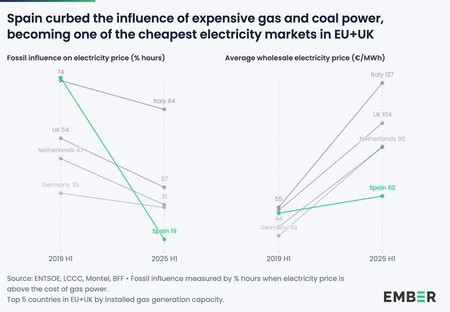
According to an Ember analysis, the impact of gas and coal on electricity prices in Spain has been reduced by an impressive 75% since 2019. In the first half of 2025, gas influenced the price of electricity only 19% of the time, a stark drop from 75% six years earlier. This transformation has positioned Spain’s wholesale electricity price to be 32% lower than the European average. In contrast, countries like Germany and Italy have only reduced their dependency on gas by 12% and 13% respectively, illustrating Spain’s rapid progress in becoming one of the cheapest electricity markets in Europe.
A Major Shift in Generation
The reduced influence of fossil fuels reflects a profound shift in Spain’s energy landscape. Since 2019, the country has added over 40 GW of new wind and solar capacity, leading to renewables covering 46% of electricity demand in the first half of 2025. Meanwhile, the contribution from gas and coal has decreased to just 20%, compared to over 40% still recorded in Germany and Italy. “Spain has broken the disastrous link between electricity and fossil fuels,” notes Chris Rosslowe, an Ember analyst.
Stability Challenges Post-Blackout
Despite this remarkable achievement, the success is not without its challenges. The stability of the electrical system remains a concern. Following a significant blackout on April 28, 2025, the Red Eléctrica de España (REE) adopted a “reinforced” operational mode. Gas-powered combined cycles were activated to stabilize the grid, which, while effective in avoiding further outages, came at a hefty price.
In May 2025, the use of gas for network services — such as voltage control and frequency regulation — doubled compared to the previous year. Following the blackout, the representation of these services in the final electricity price climbed dramatically from 14% to 57%. Moreover, the wasted renewable energy due to system inefficiencies tripled—rising from 1.8% in prior years to 7.2% between May and July 2025—indicating that a portion of clean generation is lost because the system cannot effectively manage it.
Bottlenecks and Underinvestment
Ironically, while Spain has made significant strides in renewable power, it invests only 30 cents in electrical networks for every euro allocated to renewables—a stark contrast to the 70 cents average across Europe. Despite being the fourth largest electricity market on the continent, it ranks thirteenth in battery capacity, with a mere 120 MW installed.
The REE has identified losses of up to 30% of renewable generation in some network areas due to insufficient infrastructure. This disconnect hampers the full utilization of renewable energy and forces the country to rely on gas as a backup. The situation is exacerbated by the fact that only one in ten new installations can successfully connect to the network, highlighting systemic vulnerabilities.
After the Blackout: New Legislative Measures
The blackout served as a pivotal moment for Spain’s energy strategy. Although European experts have published a factual report regarding the incident, an official assessment will not be released until the end of the year. In direct response to the blackout, the Spanish Government introduced Royal Decree-Law 7/2025, aimed at strengthening the energy network, boosting storage capabilities, and facilitating access to hybrid facilities. Though parts of the decree were rejected by Congress, many measures are being implemented through alternative channels.
Among the initiatives being adopted are the integration of eight synchronous compensators, devices that stabilize voltage without using fossil fuels, and the promotion of 2,600 MW of new batteries, with 340 MW already having received permissions. The government also plans capacity auctions to ensure gas plants remain operational while long-term structural solutions are developed.
A Model for Europe
Spain’s experience offers valuable lessons for the rest of Europe. It illustrates how increasing solar and wind energy can lower wholesale prices and decrease reliance on fossil fuels. However, it also highlights the critical need for infrastructure investment and storage solutions to ensure these benefits reach consumers.
As Chris Rosslowe aptly states, “Spain has shown the way, but to maintain it, it needs to invest in clean flexibility and modern networks.” While the cost of generating electricity has decreased significantly, passing these savings on to consumers remains a pressing challenge. The focus now shifts towards building a more robust grid and storage capacity that can fully leverage the potential of renewable energy sources as Spain continues its journey towards a sustainable energy future.