
The Evolution of Space Launch: A Shift from One-Time Use to Reusability
For decades, access to space was governed by a costly model where each launch involved rockets designed for single use only. This approach created significant barriers to entry for many players in the space industry, setting a high cost per kilogram as a structural impediment. The breakthrough came with the concept of reuse, which radically redefined how launches are conceptualized. Today, this idea has established itself as the gold standard for competitiveness in the new space economy.
SpaceX: Pioneering the Reusable Rocket Revolution
The journey that led to this disruptive innovation is not without its challenges. Back in 2008, SpaceX stood at the brink of failure, grappling with multiple technical glitches with its Falcon 1 rocket, which nearly wiped out its financial reserves. As Elon Musk himself admitted, a fourth explosion would have been catastrophic for the project. Thankfully, the scenario shifted with a successful orbital launch shortly after, combined with a lucrative contract from NASA for cargo transport to the International Space Station. This pivotal moment laid the groundwork for establishing sustained reliability in aerospace launches.
Cost Transformation: From Expense to Efficiency
Traditionally, the launch phase was perceived as the most expensive and risky part of any mission. NASA’s data places historical costs between $10,000 and $20,000 per kilogram for low Earth orbit, averaging around $18,500/kg. However, the onset of reusable rockets like the Falcon 9 and Falcon Heavy brought those costs down dramatically — falling to anywhere between $1,500 and $3,000 per kilogram. This price drop opened avenues for more frequent launches, allowing companies to reassess project scales.
China’s LandSpace: Entering the Race for Reusability
In this context of increased launch frequency, a new player has emerged: LandSpace. Founded in 2015, shortly after China initiated reforms that allowed public investment in its space sector, LandSpace aims to establish a holistic ecosystem for rocket design, manufacturing, and launching. Their vision pivots around the recovery and reuse of rocket stages, with a focus on liquid oxygen and methane propellants—strategies aimed directly at reducing overall costs and supporting large satellite constellations in China.
Zhuque-3: A Bold Step in Reusable Rocket Testing
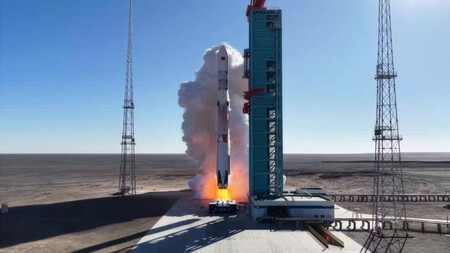
The company’s Zhuque-3 rocket represented a significant milestone for China’s commercial space capabilities. This orbital-class launcher became the country’s largest commercial rocket and, notably, the first private attempt to achieve a vertical landing after completing a mission. The launch was executed with extreme precision, featuring a purpose-built recovery area in the Gobi Desert. Although the specific success probability was not disclosed, the attempt was considered a recovery test under real conditions.
Zhuque-3 from LandSpace
Design Features: Echoes of SpaceX
The similarities between LandSpace’s Zhuque-3 and SpaceX’s Falcon 9 are striking and intentional. The Zhuque-3 incorporates design elements that are immediately recognizable—nine engines in the first stage, aerodynamic control through grid fins, and legs for vertical landing. Still, it diverges from a simple imitation: this rocket is constructed from stainless steel and utilizes methane and liquid oxygen as propellants, features that are increasingly aligned with future goals like the Starship program.
Recent Challenges and Future Directions
However, the journey has not been seamless. A recent attempt to land Zhuque-3 did not go as planned. After successfully completing its launch phase, the first stage failed to execute the landing maneuver correctly, resulting in an undignified impact instead of a controlled landing. This test was designed to assess reuse capabilities, and while it ended in failure, the data gleaned is invaluable for future endeavors.
Redefining Risk in the Space Sector
The commitment to reusable rocketry forces a reevaluation of risk perceptions within the Chinese space industry. Historically dominated by state-owned enterprises that shun visible failures, the introduction of private firms like LandSpace is fostering a culture more inclined toward controlled experiments. By publicly documenting and analyzing failures, the industry appears to be transitioning from a focus on immediate success to a long-term accumulation of experience—an essential step toward making reusable launches a reliable norm.
Images | LandSpace | SpaceX