
The Enigmatic Incident of United Airlines Flight 1093
A shattered windshield , a pilot with his arm covered in cuts, and United Airlines Flight 1093 diverted for an emergency landing . The Boeing 737 MAX 8, scheduled to fly from Denver to Los Angeles, has become the latest aeronautical mystery after a mysterious object apparently struck the cockpit at an altitude of 36,000 feet.
What We Know. The United States National Transportation Safety Board ( NTSB ) is investigating a remarkable incident that occurred on Thursday while the aircraft was cruising over Moab, Utah . Photos from the scene reveal the captain’s side windshield was entirely splintered, the center console of the plane was splattered with glass, and the pilot sustained several cuts and abrasions on his arm. Initial reports indicate that the captain speculated they might have been struck by a piece of metallic space debris . Upon landing in Salt Lake City, a 3.5-inch impact mark was discovered on the outer panel of the windshield, yet the cabin remained intact without any signs of depressurization.
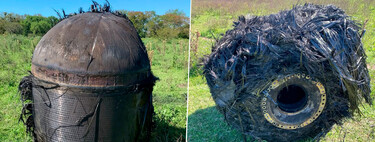
<img alt="A huge fuel tank has fallen from the sky in Argentina. And now we have a suspect: a Chinese rocket" width="375" height="142" src="https://i.blogs.es/43d332/cohete/375_142.jpeg"/>Space Junk? The damaged windshield has been sent to the NTSB laboratories for further analysis. Investigators are currently leaning away from the hypothesis of space debris and are instead considering a more mundane explanation: the possibility of a weather balloon . While space debris continues to be a concern, the Federal Aviation Administration (FAA) evaluates the risks of satellite or rocket collisions as “minuscule.” According to their research, the odds of an injury occurring due to such an incident are “less than one in a billion.” Renowned science communicator Scott Manley notes that modern satellites are designed to disintegrate into small fragments, significantly lowering the risk of impact.
Is it a Balloon? If space debris isn’t to blame, what could have caused the damage? An image demonstrating the extensive impact on the aircraft’s fuselage suggests the plane might have encountered hail . While hail is rare at 36,000 feet, it is not impossible . The NTSB’s investigation currently leans toward the theory that the cockpit was struck by a “piece of a weather balloon data packet,” according to aviation experts at AVBrief . These satellites collect weather data and often reach altitudes between 25,000 and 40,000 feet. If the object was indeed part of a weather balloon, it’s curious that the pilot initially confused it with a piece of space debris.
Windshield Integrity. Regardless of what hit the aircraft, photographic evidence suggests that the windshield failed to perform its protective function. Windshields in a Boeing 737 typically feature multiple layers: an outer and inner glass pane, with a polymer layer sandwiched between them. Although the impact did not cause cabin depressurization , it resulted in the inner glass layer fracturing violently, which propelled “glass dust” and tiny fragments toward the cockpit and injured the pilot.
After the incident, the crew descended to 26,000 feet to minimize the pressure differential over the damaged windshield. They managed to land without any further complications. The ultimate understanding of what precisely struck Flight 1093 will rest on the forensic analysis being conducted by the NTSB on the shattered windshield.
The incident raises numerous questions about the safety of aviation amidst evolving aerospace technology and the increasing presence of objects in the atmosphere . As discussions surrounding space debris and weather balloons become more pronounced, investigators will have to consider all possible factors that jeopardize commercial flights.
Ultimately, ongoing investigations will provide more clarity on this baffling incident and strengthen future safety protocols. The incident serves as a reminder of the complexities and dangers inherent in aviation today.
Images | JonNYC
In Xataka | Three large pieces of space debris reenter every day: “one day our luck will run out and they will fall on someone.”