

This Monday at Mañanera of the people, President Claudia Sheinbaum firmly denied reports suggesting that the U.S. government may be conducting surveillance flights using drones over Mexican territory.
“If there were aircraft that were to fly over Mexican territory, it would have to be exclusively under the coordination of Mexico and at our request for some surveillance support,” declared the President. She emphasized that any such operations should take place within a framework of cooperation and have historically been part of agreements that respect national sovereignty .
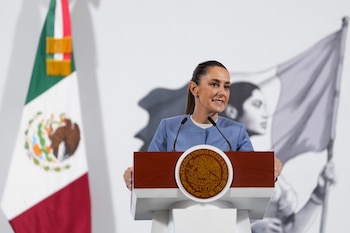
The President reiterated that respect for Mexican territory is a cornerstone of her administration. She emphasized, “It has to be clear to all Mexicans that we will never put our sovereignty at risk. Never.” This strong statement highlights her administration’s commitment to maintaining national integrity.
Furthermore, Sheinbaum highlighted the necessity of Mexico’s independence, stating, “We are a free, sovereign, and independent country.” She remarked, “We collaborate and coordinate on security issues, but we would never subordinate ourselves, nor ever allow the North American Army or any other institution of the U.S. to step onto Mexican territory. Never.”
She maintained that while there might be instances of coordination for specific matters, true sovereignty cannot be compromised. The President remembered an expression that underscores the gravity of respecting boundaries, emphasizing the sacrifices made for the nation: “If a strange enemy trespasses our land, think of the homeland that every soldier gave their life for.”
This statement comes amid rising speculation about President Donald Trump’s inclination to consider drone strikes against drug trafficking cartels operating in Mexico. Such proposals amplify concerns regarding sovereignty and territorial integrity.
President Sheinbaum has been clear that military interventions will not be accepted without explicit Mexican authorization. She underscored that no external action would resolve the complicated issue of drug trafficking, affirming that cooperative measures should continue without foreign interference. The fight against crime must rely on intelligence, research, and institutional coordination.
Experts and former officials have voiced skepticism about the effectiveness of drone strikes, warning that they could prove to be a double-edged sword, potentially exacerbating diplomatic tensions and undermining collaboration with Mexico. Unlike other narcotics, substances like fentanyl are produced in small and mobile laboratories, complicating the targeting of military operations.
In light of current policies, Mexico has extradited numerous alleged organized crime leaders and has mobilized 10,000 soldiers to the northern border as a direct response to pressure from the United States. Analysts advocate for a holistic approach to countering drug trafficking, one that focuses on neck-deep efforts like attacking money laundering structures, enhancing border technology, and compromising the chemical industry, along with initiatives aimed at preventing violence instead of solely relying on military tactics.