
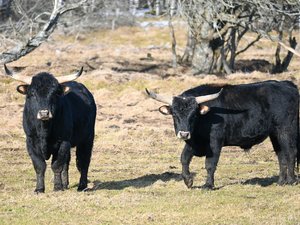
Almost 400 years after their extinction, Aurochs will be reborn in the form of bullfighting in Denmark. Thirty of these cattle from a retro-cross-country program will be reintroduced on the island of Lolland , as part of a Rewilding project supported by the Hempel Foundation , to restore natural ecosystems.
Disappeared for almost 400 years, the Aurochs —the wild ancestors of modern cattle—are preparing to make their return to European landscapes. On the island of Lolland , in the southeast of Denmark, a Rewilding project led by the Hempel Foundation plans to reintroduce cattle closely related to these great herbivores. The initiative aims to restore forgotten ecosystems, as reported by Geo.
Why Have These Cattle Been Extinct Since 1627?
Aurochs became extinct in 1627 due to a combination of hunting and the loss of habitat . This species, known scientifically as Bos primigenius , has lived back through a retro-crossbreeding program initiated in 2008 by Rewilding Europe : the Tauros Program . This program employs six ancient European cattle breeds to create an animal as genetically and morphologically close to the Aurochs as possible. These new cattle are collectively termed Tauros .
Read also: Thousands of green birds in the sky of Montpellier: how the necklace parakeet is increasingly essential in our city centers?
As noted by Ronald Goderie, the director of Grazelands Rewilding : “The main idea of the Tauros program is to reproduce these animals to establish a wild bovine species, completely autonomous, which genetically approaches the original Aurochs.”
30 Tauros Will Be Released
According to the Hempel Foundation , a total of 30 Tauros will soon be released in the Saksfjeld Vildmark reserve, an area that spans 800 hectares . These impressive cattle stand up to 1.80 meters at the shoulder and can weigh over 1.4 tonnes , boasting horns that can exceed 90 centimeters in length.
Read also: “Everyone has their eyes riveted on Thau”: the young big pears of the pond at the heart of a new project to safeguard the species.
Ultimately, the goal of this ambitious project is to develop, within the next twenty years , several self-sufficient herds of 150 individuals in different European landscapes, effectively reintroducing these magnificent animals to their former habitats.
The reintroduction of the Tauros also emphasizes the need for anthropogenic landscapes to incorporate biodiversity . The Aurochs played a crucial role in maintaining the ecosystems they inhabited, and their modern equivalents may help restore balance in contemporary environments. This initiative signals a shift towards more sustainable land management practices and highlights the importance of genetic diversity in livestock.
As more Europeans become increasingly aware of the need to protect and restore natural ecosystems, the successful reintroduction of the Tauros could serve as an inspiring model. Not only does this project aim to bring back a species thought to be lost forever, but it also embodies a commitment to rewilding and a greater understanding of wildlife conservation. The success of this endeavor may also inspire similar projects across the globe, aligning with broader goals of environmental restoration and biodiversity conservation .
This initiative represents more than just the reemergence of a long-lost species; it is a bold testament to what can be achieved through collaboration between conservationists, the community, and organizations dedicated to restoring the planet’s ecological heritage.