
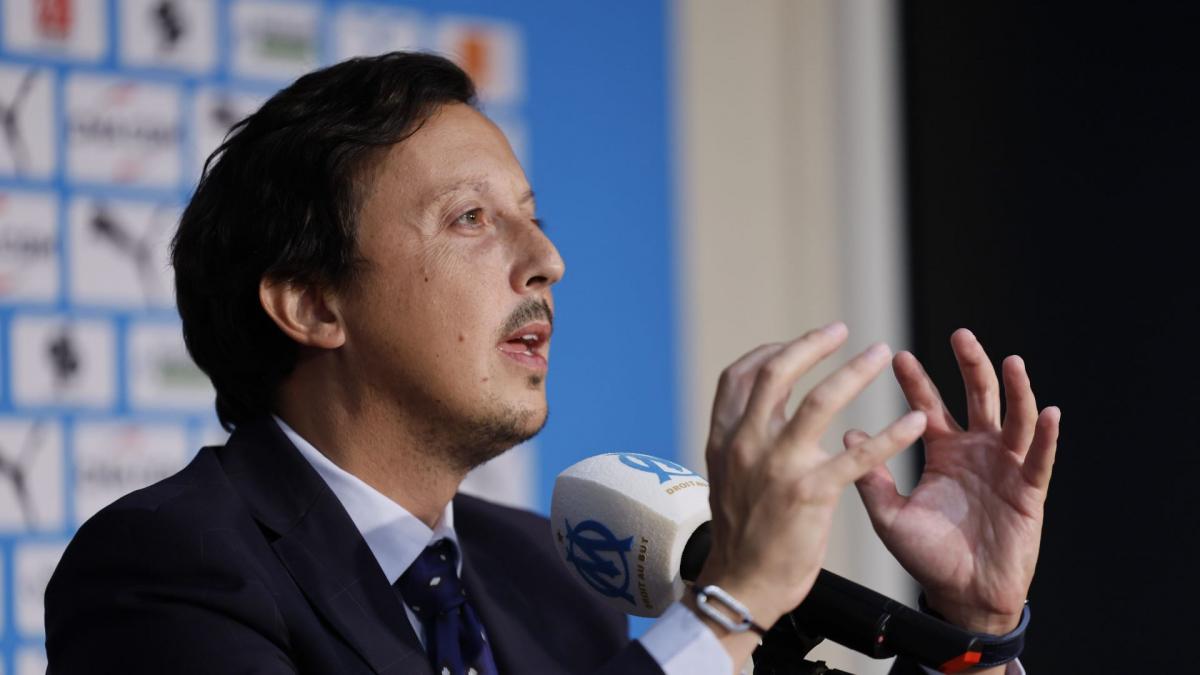
“What corruption ! It is total corruption in this championship .” These were the passionate words of Pablo Longoria, the president of Olympique de Marseille (OM), at the Stade de l’Abbé-deschamps last January. This outburst came after a controversial match against AJ Auxerre, which saw Longoria suspended for 15 games, a punishment that reflects the increasing tensions within French football. As the echoes of his heated remarks reverberate in the current football landscape, it’s essential to examine the underlying issues that led to this controversy and its ongoing impact on Ligue 1.
<div class="adWrapper adWrapper--m">
    <span>The continuation after this advertisement</span>
</div>

<p>Recently, during a  Ligue 1 board of directors  meeting, Longoria found himself back in the spotlight. As the atmosphere turned tense with discussions about the future of football governance in France, Frank McCourt, owner of OM, pushed for the ouster of Vincent Labrune, the head of the LFP (Ligue de Football Professionnel). However, the brunt of criticism was directed at Longoria, as several Ligue 1 presidents questioned his role as a representative of the league. This point of contention illustrates the  fractured relationships  and  political tensions  among the clubs.</p>

<div class="adWrapper adWrapper--m">
    <span>The continuation after this advertisement</span>
</div>

<h3>Waldemar Kita's Offensive Remarks Against Pablo Longoria</h3>

<p>The criticism didn’t stop there. Waldemar Kita, president of FC Nantes, vocally condemned Longoria’s previous tirade against the league. Having previously caused controversy with a  racist comment  on live television, Kita’s recent remarks only added fuel to the fire. He stated, <em>"You are not ashamed, who are you to say that? When you spit on the country, it is not possible, and it is a Pole who speaks to you."</em> This intense backlash showcases the fractured politics within Ligue 1, where Longoria’s fiery remarks have clearly left a bitter taste among his peers.</p>

<p>The  confrontation  between Longoria and Kita underscores a larger narrative in French football, which goes beyond mere disagreements. It illuminates the emotional stakes in a league where clubs are fiercely proud of their heritage and success. Longoria’s  impassioned  statements have led to the  crystallization of tensions  between OM, its president, and rival clubs, particularly in the wake of perceived favoritism and questionable officiating.</p>

<p>The broader implications of this fallout are significant. Where there is division, there is potential for  further conflict . As clubs jockey for position both on and off the pitch, the question arises: how will this impact the governance and integrity of Ligue 1 as a whole? With many presidents now publicly demanding Longoria's resignation from his representative role, the complications are likely to escalate.</p>

<p>In recent history, Ligue 1 has faced its share of challenges, including issues surrounding  match officiating , player conduct, and club governance. The political rifts exposed by Longoria's angry outburst—with his substantive criticism of the league officials—could become a  flashpoint  for broader systemic changes within the French football establishment. With Franc McCourt’s backing of Labrune’s removal also hinting at deeper strategic implications, these ongoing disputes may lead to further  restructuring  of leadership that could shape the future of French football.</p>

<p>Moreover, the ongoing  battle for control  over Ligue 1 could impact the league's financial health, audience engagement, and its global reputation. Stakeholders must be mindful of how  public perceptions  could shift in light of such controversies, as football is not just a sport—a  multinational  industry—whose operations can bear far-reaching consequences from power struggles at the top.</p>

<p>In light of these challenges, it is more important than ever for those involved, from club presidents to the LFP board, to find a collaborative path forward. As the lines of conflict deepen, stakeholders in Ligue 1 must navigate the intricacies of both politics and  football culture  to maintain the integrity and popularity of the league. Open dialogues, clear accountability, and a unified vision for the future may serve to not only mend fractured relationships but also to strengthen the foundations upon which Ligue 1 stands.</p>