
Senators Approve Salary Suspension During Government Shutdowns
Overview of the Resolution
In a significant move, U.S. senators have unanimously approved a resolution allowing for the suspension of their salaries during federal government shutdowns. This resolution seeks to impose direct financial repercussions on lawmakers after a series of budgetary disruptions that have hindered government operations over the past year.
Implementation Timeline
The measure is set to take effect after the general elections on November 3. According to the resolution, the Senate secretary will withhold senators’ salaries until funding is restored. Notably, this move does not extend to members of the House of Representatives, as reported by The Associated Press.
Historical Context of Government Shutdowns
This resolution comes in the wake of the longest partial government shutdown on record, which saw the Department of Homeland Security close its doors for an extended 76 days. Previously, a complete shutdown lasted 43 days, setting a troubling precedent both in duration and economic ramifications.
During these shutdowns, numerous federal employees faced financial difficulties while lawmakers continued to receive their salaries, following the stipulations set forth by the U.S. Constitution.
Accountability and Legislative Responsibility
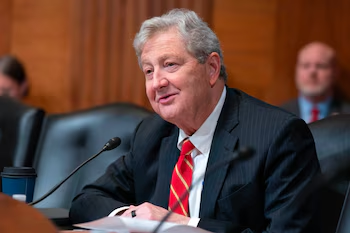
Senator John Kennedy, a Republican from Louisiana and sponsor of the resolution, stressed that government closures should not become the default response to legislative disagreements. In his remarks, Kennedy highlighted the resolution as a way to ensure lawmakers bear similar financial consequences as federal employees during shutdowns. He stated, “It’s about putting our money where our mouth is.”
Senators currently earn an annual salary of $174,000. While previous commitments have been made by legislators to forgo pay during shutdowns, the impact has often been negligible due to their overall wealth. Kennedy defended the resolution as a step toward enhancing legislative accountability, although he acknowledged that “It’s not going as far as I would like, but it’s a start.”
Exclusion of the House of Representatives
The resolution, however, does not extend to the House of Representatives. Kennedy clarified that the House operates independently and has its own procedures. He likened the ongoing conflicts between the chambers to “two kids in the back of a minivan,” hinting at the ongoing tensions.
Proposed Constitutional Amendments
In the wake of stalled initiatives to amend the Constitution directly, the Senate supported this resolution as a practical alternative. Earlier, Senator Lindsey Graham proposed a constitutional amendment requiring all members of Congress to forfeit their salaries during shutdowns. However, he acknowledged that such amendments would require ratification from three-quarters of the states, making it a long and arduous process.
Conclusion: A Reflection on Political Accountability
The new resolution aims to address both internal and external pressures for the political class to face consequences similar to federal employees whenever Congress fails to fulfill its fundamental duty—ensuring adequate funding for the government. As Sen. Graham stated, if Congress members were required to relinquish their pay during shutdowns, there would likely be fewer occurrences, and they would last for shorter durations.
With this resolution, the Senate takes a notable step toward enhanced accountability in U.S. fiscal policy, reinforcing the need for lawmakers to act responsibly amidst budgetary challenges.