Cutting Down the Journey to Mars
Traveling to Mars has long been perceived as a daunting challenge, often taking nearly 8.5 months for a one-way trip. However, a groundbreaking study from scientists at the State University of Rio Janeiro suggests a potential shortcut that could shorten the journey to just 153 days round trip. This revelation opens a new chapter in our quest to explore the Red Planet.
The Asteroid Advantage
The key to this newfound path lies in asteroids. Researchers have focused on the unique orbital trajectories of asteroids that intersect both Earth and Mars. By considering the orbital plane of asteroid 2001 CA21, researchers have identified alternative trajectories that were previously undiscovered. This approach allows for faster travel routes, significantly reducing the time astronauts would spend in space.
Not Using Asteroids as Vehicles
It’s important to clarify that this study does not promote using asteroids as actual vehicles for space travel. Instead, these celestial bodies serve to illuminate potential new trajectories that link Earth and Mars. By exploring different connection points between these orbits, more efficient and direct paths can be uncovered.
Traditional Travel Methods
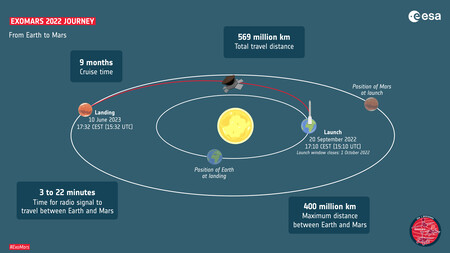
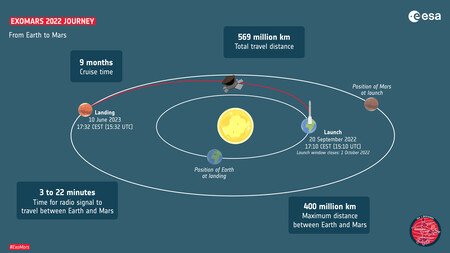
Typically, trips to Mars employ the Hohmann trajectory, which utilizes the gravitational pull of the Sun to create an elliptical orbit. This method requires precise timing and alignment between Earth and Mars, resulting in longer wait times and extended travel durations.
Planned trajectory for ESA’s ExoMars
Exploring New Orbital Plans
The orbits of celestial objects do not all align on the same plane. While Earth’s and Mars’s orbits are similar, the asteroid in question has a more tilted and varied trajectory. This distinctive tilt allows for the exploration of trajectories that resemble secondary routes in a video game, creating the potential for different travel scenarios.
Future Launch Windows
The authors of the study identified three launch windows that could potentially align the Earth, Sun, and Mars: 2027, 2029, and 2031. Among these, 2031 stands out as presenting the best conditions for a quicker journey, making it an optimal time for space agencies to plan missions.
In the most favorable scenarios, astronauts could reach Mars in as little as 33 days, considering an overall trip time of 153 days. Even in less ideal situations, the journey remains significantly shorter than the historically typical nine months.
Expanding the Horizons
While the focus of this research was on a single asteroid, scientists believe that similar trajectories could be found through the study of other asteroids. The takeaway is clear: exploring beyond conventional methods can reveal many interesting pathways to Mars.
The Need for Enhanced Propulsion
While the potential for shorter travel times is exciting, a significant challenge remains—effective propulsion systems. Current technology may not provide the needed energy to make these journeys a reality. Advancements in propulsion systems are crucial, and possibilities include nuclear energy and even experimental laser propulsion.
Looking Toward the Future
The journey to Mars is still an evolving narrative. Shorter travel times highlighted by new paths are promising, but they rely heavily on significant advancements in propulsion technology. As we look ahead, it is clear that innovation in both routes and technology will be pivotal in our quest to make human presence on Mars a reality.