
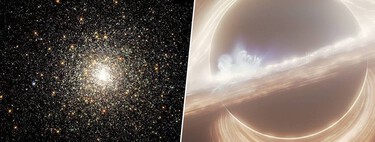
Search for Intermediate Mass Black Holes: A New Methodology
Astrophysics has advanced considerably in recent years, leading to a deeper understanding of black holes. While we are familiar with two main categories—supermassive black holes, with masses ranging from 100,000 to 10 billion solar masses, and stellar black holes, which are typically between 3 to 100 solar masses—the existence of intermediate mass black holes (IMBHs) remains a significant question in the field. These black holes, which would have masses between 100 and 100,000 solar masses, have eluded direct detection until now.
The Method: Gravitational Microlensing
A team of scientists from Yangtze University in China has proposed a novel method to search for IMBHs using gravitational microlensing of fast radio bursts (FRBs). Gravitational microlensing occurs when a massive object, such as a black hole, is positioned between a light source and the observer. This massive object’s gravity distorts space-time, causing the light path to bend, resulting in multiple or magnified images of the light source.
By thoroughly analyzing a catalog of FRBs, the researchers aimed to identify signals distorted by gravitational microlensing. Through this analysis, they have identified two candidate objects that could be classified as intermediate mass black holes.
Understanding Fast Radio Bursts
Fast radio bursts are intense, short-duration bursts of radio waves originating from beyond the Milky Way. While their precise origins are still debated among scientists, many FRBs occur frequently, sometimes appearing in large numbers each day. The ability to analyze FRBs in conjunction with gravitational microlensing offers a promising avenue for identifying otherwise invisible celestial objects.
Two Promising Candidates
In their findings, the scientists identified two bursts that exhibited characteristics consistent with IMBHs. The first candidate had a mass estimate between 539 and 609 solar masses, while the second ranged from 1,544 to 2,571 solar masses. Remarkably, these candidates are located in isolated space, without nearby galaxies or clusters. This suggests they may be primordial black holes formed during the early universe, possibly providing clues about the origins of dark matter.
Implications for Understanding Dark Matter
The significance of these findings extends beyond just identifying IMBHs. The team suggests that these black holes may also offer insights into dark matter, a mysterious substance that is thought to make up a large portion of the universe’s mass. One hypothesis posits that dark matter contains primordial black holes, although definitive proof of these objects remains elusive.
Conclusion
In this groundbreaking study, the researchers have presented compelling evidence that could yield significant advancements in our understanding of both intermediate mass and primordial black holes. Their work opens up avenues for further exploration, revealing the vast mysteries of the universe and the crucial roles these cosmic entities play.
As we continue to investigate these profound questions, one thing is clear: the hunt for intermediate mass black holes could lead to revelations that reshape our understanding of the cosmos.