

Theory (and experience in some cases) tells us that when we drink too much, the next day is literally hell. However, despite being one of the most common afflictions in many societies, science continues to reveal the exact mechanisms that are activated in our body when the party is over. And far from being a simple problem of dehydration, the “morning after” is a complex chemical, immunological, and cognitive breakdown.
A Body Map of Hangover Effects
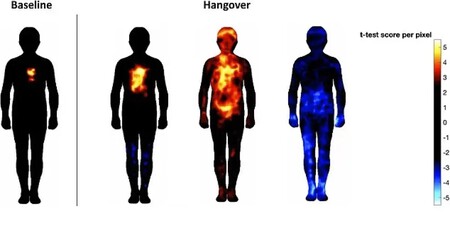
Researchers have embarked on a groundbreaking project to create a map detailing the effects of excessive drinking. The Catholic University of Leuven utilized a mobile app to monitor 34 young habitual drinkers. This innovative approach aimed to comprehensively track how participants experience physical sensations after a night of heavy drinking.
Using the app, participants were able to cross-check questionnaire data, indicate the intensity of their hangover, and assess the quality of their sleep. Additionally, they pinpointed areas of discomfort, weakness, or numbness in real-time, revealing that a hangover encompasses far more than just a headache or dry mouth.
Understanding the Results
Once all participants had visualized the areas of discomfort, clear patterns emerged. Notably, the pain predominantly affected the temples and stomach, where hyperactivity in motility was reported. Conversely, areas indicating numbness or heaviness appeared in colder colors on their maps, signifying deactivation effects. Intriguingly, these “hangover maps” went beyond mere psychological effects; they aligned with measurable physiological alterations, such as variations in heart rate and visceral signals.
Beyond the Lab: Real-World Implications
Traditionally, alcohol’s effects have been studied under controlled laboratory conditions, where all variables are meticulously monitored. However, this approach can feel disconnected from the real-world consumption patterns of individuals. This recent study’s naturalistic touch provides much greater validity, as it captures an authentic representation of the multi-systemic experiences associated with hangovers.
Now, a genuine illustration of how hangovers affect the body in everyday life is emerging, balancing scientific rigor with realistic drinking behaviors.
A Key Risk Pattern
At the heart of this study is a vital neuroscientific concept known as interoceptive phenomenology—the brain’s ability to perceive and process internal bodily signals. Mapping the experience of alcohol consumption and hangovers is essential for identifying risk patterns related to alcoholism.
Research suggests that the way we process physical sensations can directly correlate with vulnerability to addiction. Interestingly, individuals who experience minimal physical effects during their hangovers may face a higher risk of developing alcohol use disorders; they may not feel compelled to set limits on their drinking. Early identification of these risk factors could prove crucial in addressing problems involving alcohol abuse and potentially saving lives.
Images | wirestock at Magnific
In Xataka | There are scientists dedicated for decades to studying hangovers: what thousands of drunken binges (analyzed) have concluded afterwards.