
In just five months, Sandisk shares have soared 1,000% in one of the most astonishing recoveries in Wall Street history. The company has become a significant beneficiary of the AI boom and the rush to build data centers filled with advanced AI chips and accompanying memories. This extraordinary rise can be attributed to Sandisk’s strategic asset known as Kioxia.
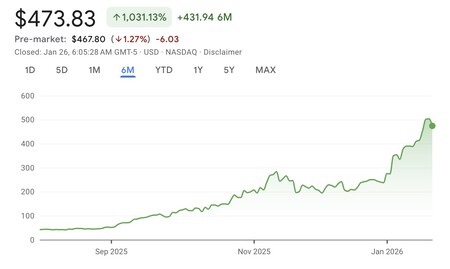
Value of Sandisk shares in the last six months. Source: Google Finance.
Sandisk’s Strategic Position in the AI Landscape
Without knowing it, SanDisk was ready for the revolution. Historically, high-bandwidth memory (HBM) has accompanied GPUs in driving AI advancements. However, a scarcity of these high-bandwidth components has spotlighted the importance of DRAM and NAND memories, where Sandisk excels. Other notable manufacturers, including Micron, have similarly found themselves in advantageous positions amidst this shift.
The Phenomenon of ‘Free Money’
Free money. The memory chip market operates like a commodity market, where prices can fluctuate dramatically. Thus, rising prices allow companies like SanDisk to earn significantly more without necessarily investing in new factories or hiring additional employees. This situation has been akin to “free money.” SanDisk CEO David Goeckeler, emphasizing the unpredictable rise of AI in June, stated, “We think demand is good. What we need is to get supply to match that.” Unfortunately, the surge in memory demand took everyone by surprise starting in September.
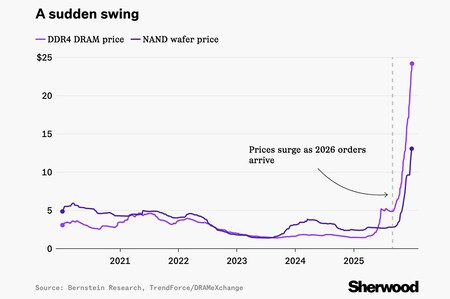
DRAM and NAND memory prices are skyrocketing from the end of 2025. Source: Sherwood.
The Kioxia Advantage
The key alliance: Kioxia. Sandisk has made significant strides in its solid-state drive (SSD) business for enterprise data centers. A historical alliance with the Japanese company Kioxia allows Sandisk to source NAND chips at a lower cost than competitors, significantly boosting profit margins and contributing to an impressive rise in stock prices.
A Complex Relationship
The relationship between Sandisk and Kioxia, established over 20 years ago, revolves around developing NAND memories. Their collaboration has led to innovations like BICS Flash (3D storage technology), with manufacturing processes shared between both companies. Despite facing challenges in the wake of Toshiba’s financial difficulties, both companies have thrived, now controlling 30% of the global NAND market together.
Market Dynamics: Winners and Losers
Some win, others lose. In early 2025, investment fund Elliot Management advocated for Sandisk to separate from Western Digital, believing its worth was around $20 billion. Having sold its stake before the market soared, the same stake today would be valued at over $340 million.
The User Perspective
Bad business for users. However, the consequences of this market dynamic will likely fall on users, who may face challenges for months, if not years. Neither Micron nor Sandisk/Kioxia seem inclined to expand production, having previously experienced overproduction during the pandemic. The anticipated price increases may persist throughout 2026, making it uncertain when—if ever—prices might return to previous levels.