
Samsung has been strategically maneuvering within the premium television market for years, consistently seeking alternatives to traditional OLED technology. From QLED to Mini LED, and more recently QD-OLED, Samsung has embarked on a journey defined by innovation and differentiation.
At CES 2026, Samsung unveiled a significant breakthrough: the world’s first 130-inch Micro RGB TV. This new technology, neither OLED nor MicroLED, aims to set itself apart by directly delivering color to the light source, marking a milestone in Samsung’s mission to diversify its premium television offerings.
Introducing Micro RGB: A Game Changer
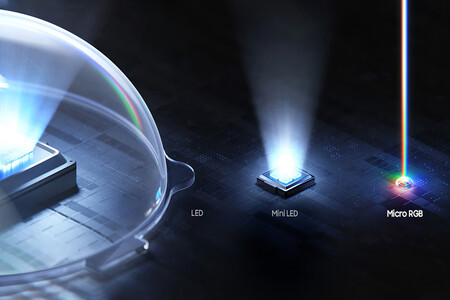
Current LCD televisions utilize an array of white or blue LEDs arranged behind an LCD panel, where color filters are used to create images. However, Micro RGB technology revolutionizes this approach. It replaces traditional LEDs with micro-LEDs that independently emit red, green, and blue colors, each measuring less than 100 micrometers. This innovation dramatically enhances color purity and reduces light intensity loss, allowing for meticulous zone control of illumination, even while still utilizing a conventional LCD panel.
The outcome is a remarkable increase in color volume, with Samsung claiming complete coverage of the BT.2020 color space, which is crucial for the film industry. Additionally, the brightness levels surpass those of OLEDs, maintaining an edge that LCDs have over organic technologies.
Micro RGB vs. QD-OLED: Two Competing Technologies
With Samsung already marketing QD-OLED televisions like the S95F, a comparison between Micro RGB and OLED technologies is inevitable. The primary distinction lies in their technological foundations: OLED and QD-OLED are self-emissive technologies, capable of turning off pixels individually for true blacks and exceptional contrast. Micro RGB, depending on backlighting, does not achieve this level of control but significantly enhances lighting management compared to previous technologies.
One of Micro RGB’s significant advantages is its elimination of the burn-in risk associated with OLED screens, enabling higher brightness and greater long-term stability—key benefits for large televisions used intensively or in brightly lit environments.
Challenges: Scaling and Cost of Production
While Samsung has showcased a 130-inch Micro RGB television at CES, its ambition is to eventually produce smaller sizes, starting from 55 inches throughout 2026. However, the path to mainstream adoption is fraught with challenges. The current production cost of Micro RGB panels is higher than that of conventional OLEDs, primarily due to the complexity involved in manufacturing high-precision RGB micro-LEDs. To achieve commercial viability in standard home sizes (55 to 77 inches), Samsung must focus on reducing manufacturing costs and streamlining assembly processes.
A Multifaceted Strategy for the Premium Market
Analyzing the broader implications, Micro RGB aligns with Samsung’s overarching strategy of ensuring it is not reliant on a single technology within the premium segment. By competing in the realms of QD-OLED and Mini LED alongside introducing Micro RGB, Samsung is diversifying its offerings to meet various consumer needs.
Ultimately, Micro RGB does not aim to dethrone OLED; instead, it seeks to carve out its niche between high-end LCD and OLED technologies. Should Samsung succeed in ramping up production efficiencies and expanding its size range, Micro RGB could shift the dynamics of a television market increasingly dominated by advanced OLED technologies.
Image credit: Samsung